


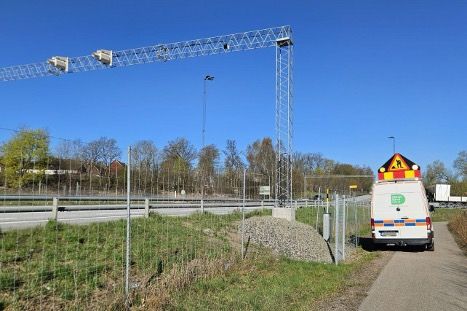
Sensys Gatso Group has completed the first installations of its gantry-mounted Automated Traffic Control (ATK) cameras on three high-traffic roads across Sweden, in collaboration with the Swedish Transport Administration (Trafikverket).
The cameras have been installed on Route 27 in Kärda outside Värnamo, the Stallbacka Bridge in Trollhättan, and Route 21 at Vanneberga, with further installations planned in the coming weeks.
The deployments form part of a wider procurement contract first announced on 8 October 2022, under which Sensys Gatso Sweden was selected to supply, install and maintain traffic safety cameras for the nationwide ATK programme over a 12-year period.
Unlike traditional roadside units, the new cameras are mounted on gantries directly above the roadway, offering a broader field of view across multi-lane roads and tunnels. “By placing the camera on a gantry above the road, we can now monitor more lanes simultaneously,” said Erik Hemgren, key account manager at Sensys Gatso Sweden.
The improved positioning also enables sharper image capture, giving police the ability to identify secondary offences such as illegal mobile phone use while driving.
The ATK programme, jointly managed by the Swedish Transport Administration and the Swedish Police Authority, aims to reduce average speeds on accident-prone roads and cut the number of crashes, fatalities and serious injuries. According to Sensys Gatso, the programme already saves as many as 20 lives per year.
“We look forward to establishing a state-of-the-art traffic safety camera system together with the Swedish Transport Administration and we are very proud to contribute to Vision Zero,” said Jörgen Andersson, managing director of Sensys Gatso Sweden AB. “The Swedish ATK programme saves as many as 20 lives per year, helping make Sweden’s roads some of the safest in the world.”
Sensys Gatso developed a specialised speed enforcement system for the programme, housed in a custom mechanical enclosure built for confined spaces and demanding environments. Rather than automated cleaning systems, the design incorporates a cone in front of the lens that generates an air column to maintain optical clarity. The company’s collaboration with the Swedish Transport Administration dates back to the early 1990s.