

Traffic Technology TodayTraffic Technology Today
  • News
    • A-D
      • Appointments & Staffing
      • Asset Management
      • Autonomous Vehicles & ADAS
      • Awards
      • Cloud Computing
      • Congestion Reduction
      • Connected Vehicles
      • Covid-19
      • Cybersecurity
      • Data & Modeling
      • Deals, Acquisitions & Mergers
    • E-J
      • Electric vehicles & infrastructure
      • Emissions & Low Emission Zones
      • Enforcement
      • Event News
      • Funding
      • Incident Detection
      • Infrastructure
      • Intersections & Traffic Signals
      • ITS
    • K-S
      • Legal / Government Regulation
      • Machine Vision / ALPR
      • Mapping
      • Mobility as a Service
      • Multimodality & Micromobility
      • Planning, Testing, R&D
      • Public transit
      • Safety
      • Smart Cities
      • Smart Parking
    • T-Z
      • Tolling
      • Traffic counting & categorization
      • Traffic Management
      • Traveler Information Systems
      • Tunnels & Bridges
      • Variable Message Signs
      • Vulnerable Road Users
      • Weather systems
  • Features
    • Features
    • Opinion
  • Online Magazines
    • November / December 2025
    • August 2025
    • May 2025
    • March 2025
    • December 2024
    • September 2024
    • Archive Issues
    • Subscribe Free!
    • > Tolltrans
  • Video & Audio
    • Video
    • Audio
  • Podcast
  • Events
  • Webinars
  • Technology Profiles
LinkedIn YouTube X (Twitter)
Subscribe >
Traffic Technology TodayTraffic Technology Today
  • News
      • Appointments & Staffing
      • Asset Management
      • Autonomous Vehicles & ADAS
      • Awards
      • Cloud Computing
      • Congestion Reduction
      • Connected Vehicles
      • Cybersecurity
      • Data & Modeling
      • Work zones
      • Deals, Acquisitions & Mergers
      • Electric vehicles & infrastructure
      • Emissions & Low Emission Zones
      • Enforcement
      • Event News
      • Funding
      • Incident Detection
      • Infrastructure
      • Intersections & Traffic Signals
      • ITS
      • Legal / Government Regulation
      • Machine Vision / ALPR
      • Mobility as a Service
      • Multimodality & Micromobility
      • Planning, Testing, R&D
      • Public transit
      • Safety
      • Smart Cities
      • Artificial Intelligence (AI)
      • Smart Parking
      • Tolling
      • Traffic counting & categorization
      • Traffic Management
      • Traveler Information Systems
      • Tunnels & Bridges
      • Variable Message Signs
      • Vulnerable Road Users
      • Weather systems
  • Features
    • Features
    • Opinion
  • Online Magazines
    1. November / December 2025
    2. August 2025
    3. May 2025
    4. March 2025
    5. December 2024
    6. September 2024
    7. Archive Issues
    8. Subscribe Free!
    9. > Tolltrans
    Featured
    April 21, 2026

    NEW ISSUE: Read the April/May 2026 edition of TTi magazine online now!

    ITS By Web Team
    Recent

    NEW ISSUE: Read the April/May 2026 edition of TTi magazine online now!

    April 21, 2026

    NEW ISSUE: Read the February/March 2026 edition of TTi magazine online now!

    February 25, 2026

    NEW ISSUE: Read the November/December 2025 edition of TTi magazine online now!

    November 30, 2025
  • Video & Audio
    • Video
    • Audio
  • Podcast
  • Events
  • Webinars
  • Technology Profiles
LinkedIn YouTube X (Twitter)
Traffic Technology TodayTraffic Technology Today
Data & Modeling

TECH PROFILE: Smarter intersections with C-ITS and modelling from PTV Vissim

Tom StoneBy Tom StoneApril 26, 20263 Mins Read
Share LinkedIn Twitter Facebook Email
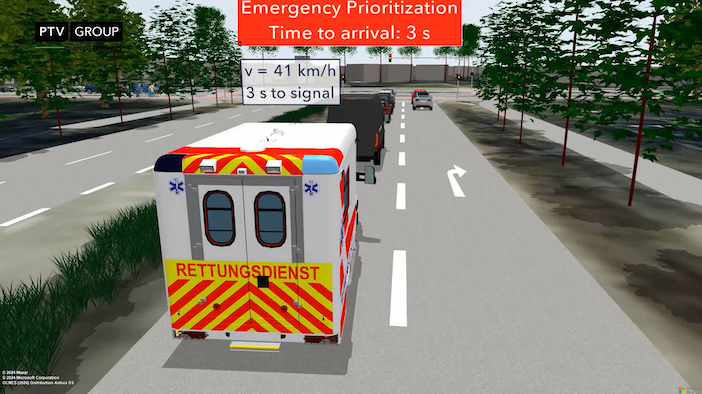
PTV Vissim simulation screenshot showing an emergency ambulance on an urban road with an "Emergency Prioritization – Time to arrival: 3s" overlay and signal-timing data.
Testing of emergency-vehicle signal priority in the PTV Vissim simulation environment – the connected ambulance transmits its speed and arrival time to a V2I-ready signal controller, which provides a green phase on arrival

As C-ITS adoption accelerates, simulation tools are helping cities test and refine connected signal strategies without disrupting live traffic

PTV Group (part of Umovity) – ITS European Congress Istanbul – Booth C4

Urban intersections remain one of the most critical bottlenecks in transport networks. As traffic volumes grow and mobility patterns become more complex, Cooperative Intelligent Transport Systems (C-ITS) have emerged as a promising technology with significant potential to improve traffic flow, safety and operational efficiency. An important tool for evaluating such connected strategies is microscopic traffic simulation.

“Road space is limited, so it is all about using existing infrastructure in the most efficient way. C-ITS is becoming increasingly important for cities worldwide,” says Matthias Pfriem, senior product manager for PTV Vissim. “Simulation helps traffic planners and engineers create a realistic testing ground for intelligent signal control, allowing them to plan, test and optimise strategies before implementation.”

Connected by design

C-ITS enables real-time bidirectional communication between vehicles (V2V), infrastructure (V2I) and other road users. Connected vehicles transmit continuous data including position, speed, vehicle type and trajectory. For traffic control systems, this greatly expands the available information base and enables more adaptive and predictive signal control strategies.

“Activating C-ITS in PTV Vissim simulations involves enabling V2I communication attributes within the simulation environment,” says Pfriem. “When those connected vehicle attributes are provided to a V2I-ready signal controller, that real-time information can be used directly in the signal control strategy for prioritisation of selected vehicles or for general optimisation of intersection performance. The simulation serves as a test-bed for exploring different control strategies in different traffic conditions and connectivity scenarios.”
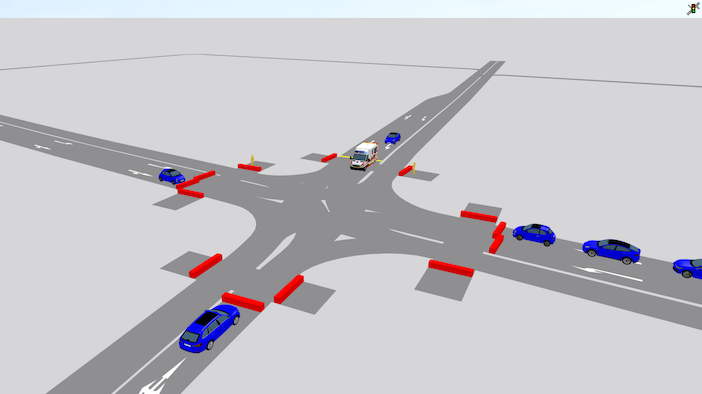
PTV Vissim 3D simulation view of a four-way urban intersection with cars and a van approaching from multiple directions and red detection zones marked on each approach.
Within the simulation, connected vehicle data is transmitted to signal control logic, which dynamically adjusts signal phases based on real-time inputs from approaching vehicles.

From data to dynamic control

Within the simulation, vehicle data is transmitted to signal control logic, which dynamically adjusts signal phases. Planners can analyse how different penetration rates and demand conditions affect intersection performance or how signal strategies respond to real-time vehicle data under varying conditions. Key indicators such as delay, queue length and intersection throughput can then be measured and compared across scenarios.

One key application is signal priority for specific vehicles. Emergency vehicles can send priority requests, allowing the signal controller to provide a green phase on arrival, reducing response times and improving safety.

Public transport benefits similarly. “Buses or trams communicating directly with the signal controller can request priority far more flexibly and precisely than traditional systems,” says Pfriem. Continuous communication enables signals to respond dynamically to approaching vehicles, improving schedule adherence while minimising impacts on general traffic.

Matthias Pfriem, senior product manager for PTV Vissim, smiling and wearing a dark T-shirt with a pink "Vsi" superhero-style logo.
Matthias Pfriem, senior product manager for PTV Vissim.

Network-wide gains

Beyond priority applications, connected traffic control also supports more advanced traffic management strategies. Continuous vehicle data helps reduce stops, shorten queues and increase capacity without infrastructure changes.

Modelling the road ahead

Simulation enables these strategies to be tested safely and systematically. Planners can evaluate configurations, identify challenges and quantify benefits before field implementation, reducing risks and supporting data-driven decision-making.

“As more vehicles become equipped with C-ITS capabilities, the potential for optimised traffic control will continue to grow. Future use cases range from dynamic lane management to improved safety for vulnerable road users. Simulation helps make this potential measurable. And as we model V2I agnostic from the communication path, PTV Vissim can be used to test approaches with direct communication via ITS-G5, via 5G cellular communication or indirect communication via cloud-backbones,” concludes Pfriem.

Share. Twitter LinkedIn Facebook Email
Previous ArticleTECH PROFILE: Navtech’s 360-degree radar for highway detection
Tom Stone

Tom has edited Traffic Technology International (TTi) magazine and its Traffic Technology Today website since May 2014. During his time at the title, he has interviewed some of the top transportation chiefs at public agencies around the world as well as CEOs of leading multinationals and ground-breaking start-ups. Tom's earlier career saw him working on some the UK's leading consumer magazine titles. He has a law degree from the London School of Economics (LSE).

Related Posts

Close-up of a Navtech 360-degree radar unit mounted on a floating-plate bracket atop a roadside pole against a clear blue sky
Incident Detection

TECH PROFILE: Navtech’s 360-degree radar for highway detection

April 26, 20264 Mins Read
Busy UK motorway with multiple lanes of traffic including cars, vans and a car transporter, with overhead gantry signs for the M61, M62, M65 and M58.
Artificial Intelligence (AI)

TECH PROFILE: Quarterhill on turning fragmented data into trusted insight

April 26, 20263 Mins Read
A 30km/h zone sign next to a road junction with a car, a tram, a cyclist and a pedestrian crossing on a zebra crossing.
Enforcement

TECH PROFILE: Advanced technology for safer intersections, from Vitronic

April 26, 20263 Mins Read
Latest Posts
PTV Vissim simulation screenshot showing an emergency ambulance on an urban road with an "Emergency Prioritization – Time to arrival: 3s" overlay and signal-timing data.

TECH PROFILE: Smarter intersections with C-ITS and modelling from PTV Vissim

April 26, 2026
Close-up of a Navtech 360-degree radar unit mounted on a floating-plate bracket atop a roadside pole against a clear blue sky

TECH PROFILE: Navtech’s 360-degree radar for highway detection

April 26, 2026
Busy UK motorway with multiple lanes of traffic including cars, vans and a car transporter, with overhead gantry signs for the M61, M62, M65 and M58.

TECH PROFILE: Quarterhill on turning fragmented data into trusted insight

April 26, 2026
FREE WEEKLY NEWS EMAIL!

Get the ‘best of the week’ from TrafficTechnologyToday.com direct to your inbox every Thursday


Supplier Spotlights
  • Conduent Transportation
    Conduent Transportation
  • Norbit ASA
    Norbit ASA
  • Teconer Oy Finland
    Teconer Oy
  • MESSAGEMAKER DISPLAYS
  • Carrida Technologies GmbH
    CARRIDA Technologies GmbH
  • triple sign system AB
    Triple Sign System AB
  • Cross Zlin
    CROSS Zlín a.s.
  • SMATS traffic solutions logo
    SMATS Traffic Solutions Inc.
  • Star Systems International Limited
Our Social Channels
  • Twitter
  • YouTube
  • LinkedIn
Getting in Touch
  • Free Email Newsletters
  • Contact Us
  • About Us
  • Supplier Spotlight

Upcoming Events

Jun 9
June 9 @ 8:00 am - June 12 @ 5:00 pm BST

ITS America Conference & Expo 2026

View Calendar
© Copyright 2026 Mark Allen Group. All rights are reserved, including those for text and data mining, AI training, and similar technologies.
  • Cookie Policy
  • Privacy Policy
  • Terms & Conditions

Type above and press Enter to search. Press Esc to cancel.