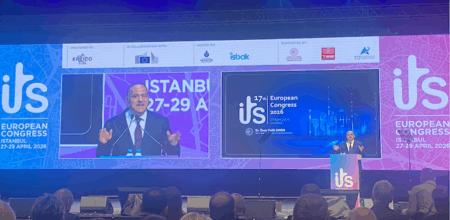


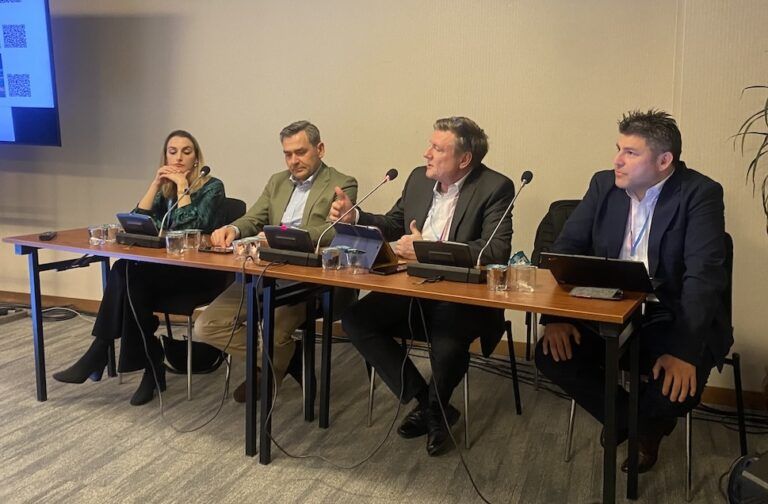
The challenges and opportunities facing V2X were laid out in detail at the ITS European Congress in Istanbul, as ERTICO-ITS Europe presented the findings of its 2026 Market Radar Report in a session dedicated to suppliers, vehicle manufacturers and the connectivity sector.

Now in its third year, the Market Radar Report series has examined a different cluster of sectors each year. Moderating the session, Agne Vaitekenaite, who leads Partnership and Advocacy at ERTICO, set out the broader context. ITS, she said, “is undergoing a rapid transformation, characterised by blurring divides between sectors,” with cross-sectoral collaboration as the central question.
Suppliers: AI and cybersecurity are non-negotiable
Thorsten Burger, head of public affairs at Aumovio and the supplier sector’s representative on the ERTICO board, framed the supplier community’s position before identifying AI and cybersecurity as the defining themes. “Everyone is going for autonomous driving, for the software-defined vehicle,” he said, “but one topic that is also non-negotiable is cybersecurity.” He also struck a competitive note: “If we look left to Asia or right to North America, we have to move forward together.”
Connectivity: exploit what exists before chasing what is next
Ralf Weber, Qualcomm’s director of standards and industry organisations, urged pragmatism on technology choices. “We are not even exploiting all the functionalities that we have in the existing system,” he said. He identified direct vehicle-to-vehicle and vehicle-to-infrastructure communication — 5G-V2X — as the most impactful near-term development, while being direct on the precondition for scale: “As long as we don’t have a real business case, no one is interested.”
OEMs: safety as foundation, hybrid communication as priority
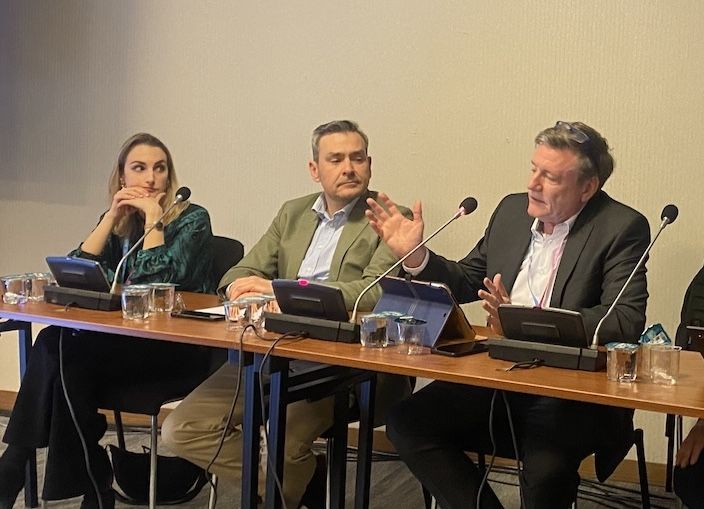
Juan Alamo, senior engineer for safety research and technical affairs at Toyota, anchored his presentation to zero crashes. He noted that 2.5 million C-ITS-equipped vehicles are already on European roads with around 3,000 roadside units in place. “This is no longer just research,” he said. His three priorities were backward compatibility across a vehicle lifespan of 11–16 years, software updateability, and a purpose-led approach to hybrid communication that matches the right technology to the right use case.
Scaling innovation: pilots, standards and open platforms

Panel discussion lead author Martina Ferrara Snider, senior support manager at ERTICO, identified three pillars for European-scale deployment: large-scale testing, protocol standardisation, and open collaborative platforms. She noted that current pilots remain fragmented and small-scale: “You cannot understand how solutions work in real-life conditions with a very limited number of pilots and vehicles.” The report anticipates greater standardisation — including on over-the-air updates and EU-wide cybersecurity rules — by around 2028, with initiatives such as ICAVA and the Eclipse Foundation’s automotive collaboration framework cited as models.
Burger returned to the supplier perspective, describing the shift from hardware to software-hardware supplier as the defining transition, and stressing that commitment is needed from every link in the chain. “If we are fighting each other, we will lose the race — and other regions are not waiting.”

Weber drew a parallel with the mobile industry’s formative period, when competitors agreed common standards to create a global system. He warned against repeating the eCall experience — technology ready in 2008, mandate not arriving until 2018, by which point it was already outdated — and called for regulations to include a “state of the art” clause allowing technology to evolve.
Alamo, broadly positive about Europe’s collaborative frameworks, pointed to the forthcoming Euro NCAP 2029 protocol as a potential forcing mechanism. His closing emphasis was on execution over elaboration: “The next step is not more frameworks. It is being more consistent about cross-border deployment.”
Audience discussion: Europe’s response to vertical integration
An audience member, Andrei, raised whether Europe needs to rethink its distributed ecosystem model given the vertically integrated approach of major Chinese players. Weber argued against building in isolation — “China is pretty far ahead with autonomous driving, and if we try to ignore that and do everything on our own, we will take much longer” — while stressing that European requirements on privacy and security cannot be disregarded. Burger noted that fragmented global markets can create opportunities for suppliers serving multiple regional ecosystems, but that accelerating deployment within Europe is the more pressing priority. Ferrara Snider added that with the shift to software-defined vehicles, developing independent full stacks is no longer efficient, and that open-source, modular initiatives like ICAVA and the Eclipse Foundation represent a form of selective integration preserving the distributed model while capturing efficiency gains.
The ITS European Market Radar Report 2026 is published by ERTICO-ITS Europe.