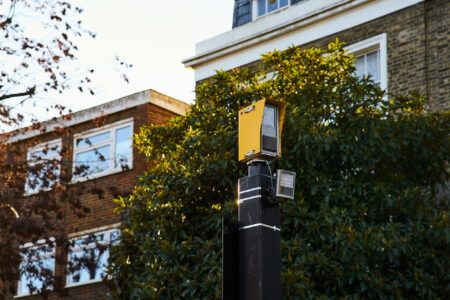


The technology that today underpins speed enforcement, congestion charging and vehicle tracking across the world was invented in the UK. Here, one of the engineers at the heart of its early commercial development recounts his insight into its early history for the first time. Geoffrey Hill, former Technical Director of Travers Morgan Ltd and a chartered member of both the Institution of Civil Engineers and the Institution of Highways and Transportation, spent nearly 50 years in highways and transport before retiring in 2013. Here, he sets down how ANPR (Automatic Number Plate Recognition) systems were first developed
In a little over 35 years, Automatic Number Plate Recognition (ANPR) has developed into a broadly applied enabling technology across road traffic speed enforcement — both fixed and variable — car park charging, vehicle tracking, journey time information, toll collection, congestion charging, vehicle emissions control and general law enforcement.
The origin of this technological revolution in the UK can be traced to the Police Scientific Development Branch (PSDB), the Home Office’s own research unit, which invented ANPR in 1976. Working prototypes were operational by 1979, with trials conducted at the Dartford Tunnel to detect stolen vehicles.
The first industrial contract was awarded to EMI Electronics. Computer Recognition Systems Ltd (CRS), a machine vision development company based in Wokingham and founded in 1981 by Bill Adaway, subsequently became the primary commercial developer of the technology.
CRS’s core business was computer-assisted CCTV in production process quality control. It was their emerging capability in machine vision that caught the attention of Travers Morgan Ltd (TML), a multi-disciplinary engineering consultancy engaged across a broad range of highway engineering projects — from national motorways down to private developer clients. An integral part of TML’s service relied upon gathering existing road traffic movement data and forecasting future vehicle movements.
The typical tools of data gathering at the time were manual vehicle counts, roadside sample interview surveys and road surface vehicle detectors. Specialist traffic survey companies were also introducing video surveys captured from high-mast cameras, with manual extraction of vehicle volume and classification data carried out in viewing suites.
TML recognised the benefits of automating these manual vehicle movement surveys — to deliver greater speed and accuracy, and to enable much broader surveys to be conducted. The goal was not only to establish current traffic flow at specific locations, but also to track vehicles in and out of a closed camera survey cordon.
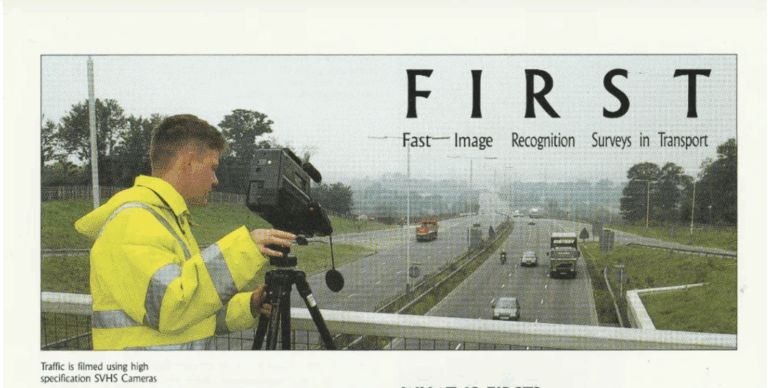
Early trials from roadside video surveys using Super VHS (25 frames per second) enabled CRS to prove their ability to identify a number plate and then read the characters, checking them against standard number plate formats. Typically, between 70% and 90% were read accurately and recorded in real time.
After several months of optimising the process, TML and CRS approached the Department of Transport to stage a demonstration of the Fast Image Recognition Surveys in Transport (FIRST) system on a challenging section of the M25 motorway, embracing all turning and through traffic movements between the M4 and M3 junctions.
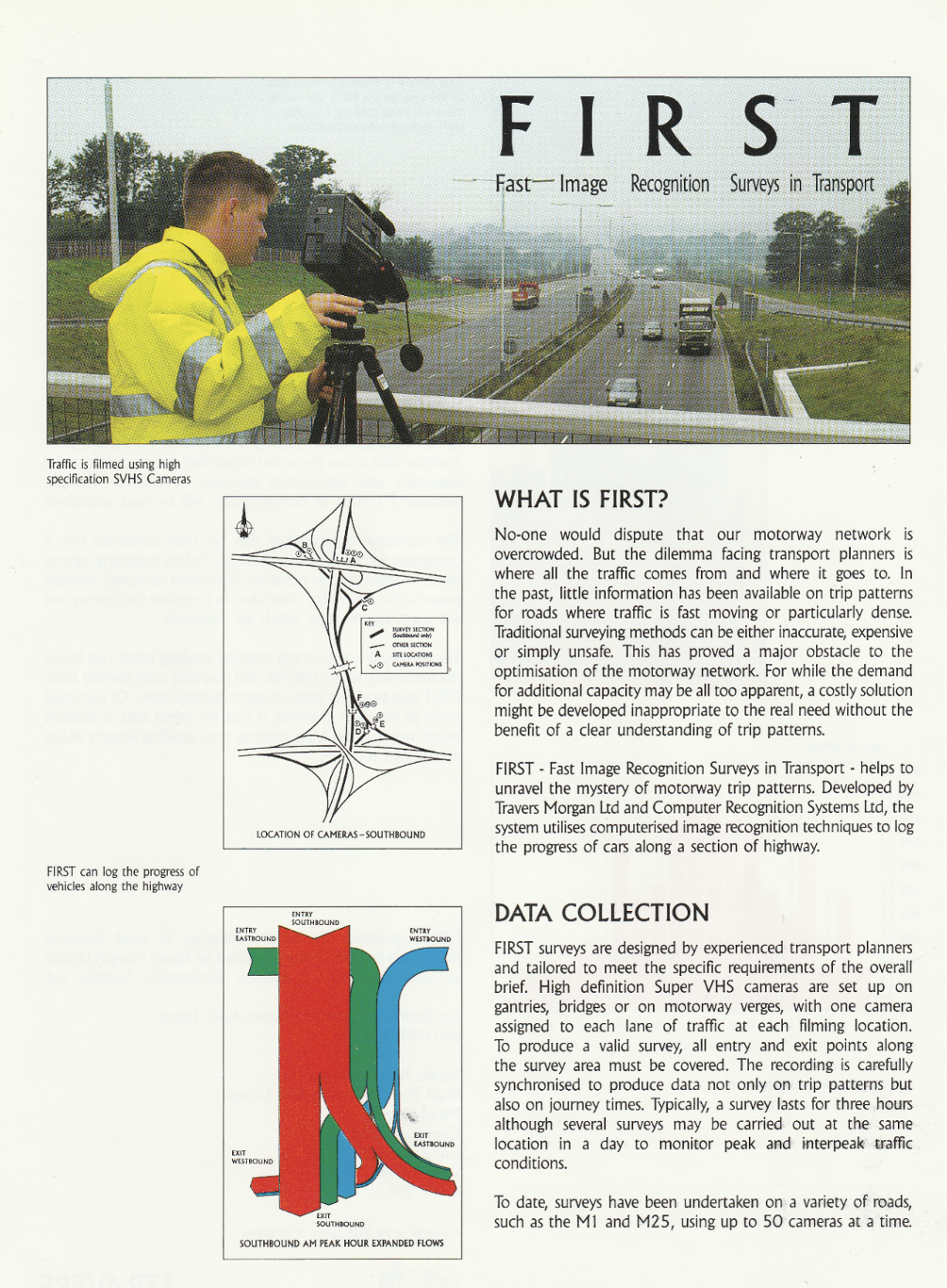
A cordon of some 50 cameras was set up on convenient motorway overbridges — one camera per traffic lane — at the M25, M3 and M4 entry and exit points. Recordings of 180 minutes duration were time-synchronised across the morning peak period. The VHS tapes were then processed through the ANPR system, and individual vehicle plate records were matched to produce the vehicle movement pattern and journey times. The matched pattern was scaled up to correspond to total observed vehicles, compensating for any unread plates.
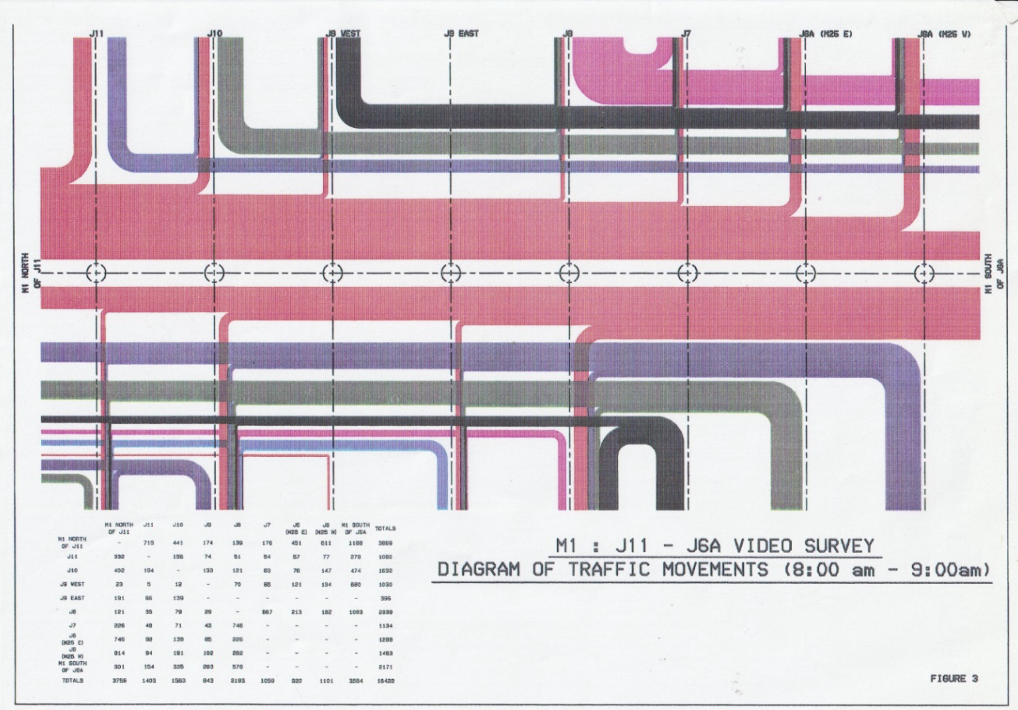
This successful demonstration introduced a new era in motorway traffic surveys, significantly increasing the speed and efficiency of the traffic survey industry. A further, larger application of FIRST was subsequently carried out on the M1 between junctions 6A and 11.
From surveys to speed enforcement
Moving forward, TML brought another potential ANPR application to CRS. Having designed a motorway widening scheme on the M20 between Junctions 5 and 8, its construction required that existing traffic pass through the works site throughout the contract period. While a statutory 50mph speed limit was imposed, driver compliance in such circumstances was poor — protecting the workforce and minimising traffic accidents was a high priority.
TML and CRS approached the Department of Transport with a proposal to trial a live speed measurement system capable of measuring individual vehicle speeds at the M20 westbound entry to the works site, using two bridge-mounted cameras. By timing each observed vehicle number plate between the two cameras, it was possible to determine vehicle speed.
NEI Control Systems joined the venture to supply a portable variable message dot matrix sign, positioned downstream of the speed-measuring cameras. The real-time system matched vehicle number plates and calculated speed. If a vehicle exceeded the 50mph limit, a simple three-line message was displayed to the driver:
The technology had not at that time been Type Approved by the Home Office, so legal prosecutions were not possible. The system was christened Speed Violation Detection Deterrent (SVDD).
The cameras were equipped with infra-red illumination, allowing the ANPR system to operate 24 hours a day. The trial was approved by the Department of Transport and conducted under the scrutiny and with the co-operation of the Parliamentary Advisory Committee for Transport Safety, Kent County Constabulary, and the Association of Chief Police Officers Standing Sub-Committee on Speed Enforcement Technology.
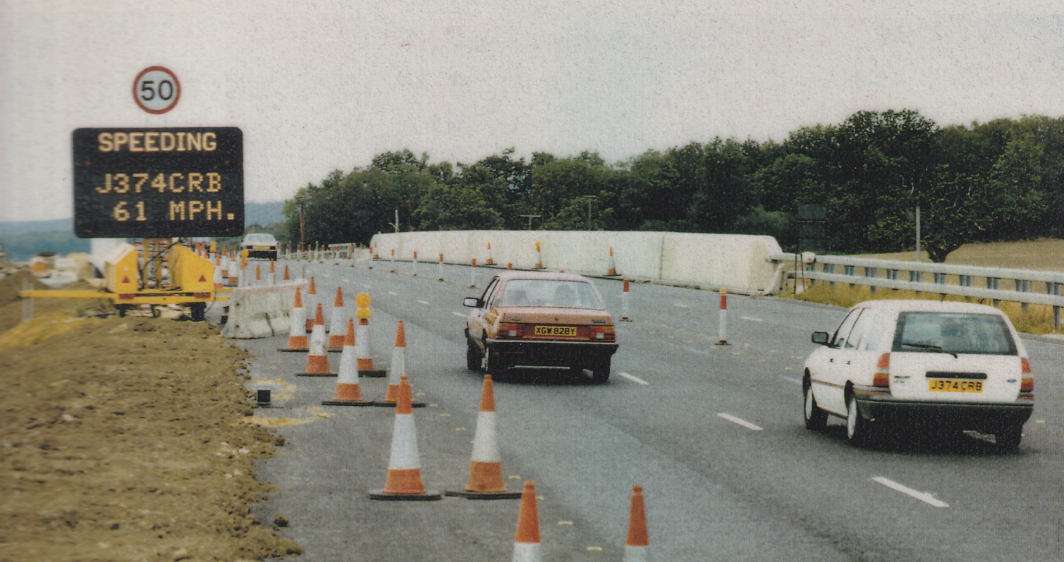
SVDD went live in covert mode — without the deterrent message display — for one week in May 1993, in order to profile vehicle speeds within the 50mph zone. Thereafter it operated in deterrent mode until the works were completed on 29 September. The deterrent effect of the VMS sign was immediate and sustained.
After two weeks of deterrent operation, the proportion of vehicles exceeding 50mph fell from 36.3% to 17%. Vehicles exceeding 60mph dropped from 7.6% to 1.6%, and those exceeding 70mph from 1.0% to 0.1%.
Kent Police concluded: “SVDD is seen as an innovative use of technology which impacts beneficially on driver behaviour and has great potential in further reducing the number of speed-related accidents.”
These results were achieved without legal enforcement — relying solely on the visual display to inform speeding drivers that their excess speed had been measured and their vehicle identified. Kent Police was nonetheless able to identify persistent offenders and issue appropriate warnings.
Building towards Type Approval
Following the M20 trial, discussions with the Association of Chief Police Officers (ACPO) focused on enhancing the SVDD process to produce a comprehensive digital record of each speed limit violation event — a prerequisite for Home Office Type Approval as an authorised law enforcement tool.
This required assembly of a full-frame image from the overhead camera at the point of entry to the average speed measurement baseline, together with the two extracted number plate images and their respective observation times. The resulting time difference allowed speed to be determined, and if in excess of the statutory limit, the registered vehicle keeper could be served with a Section 172 Fixed Penalty Notice.

ACPO also sought the introduction of a secondary method of speed verification to validate, to a lower order of accuracy, the primary average speed calculation.
A second motorway project under the design and construction supervision of Symonds Travers Morgan — renamed following an acquisition of TML — provided the opportunity to demonstrate SVDD with its full enforcement record capability. The A46 Leicester Western Bypass required a new junction (J21A) with the M1 just north of Leicester Forest East Service Area. Narrow and diverted traffic lanes required a 50mph speed limit through the M1 worksite, and SVDD was deployed on the M1 northbound carriageway.
On this occasion the cameras were linked directly, via the National Motorway Communications cable network, to the Leicestershire Police Operations Centre. The ANPR processor fed the violation record automatically, and the speeding vehicle message was returned to the roadside VMS display ahead of the offending vehicle.
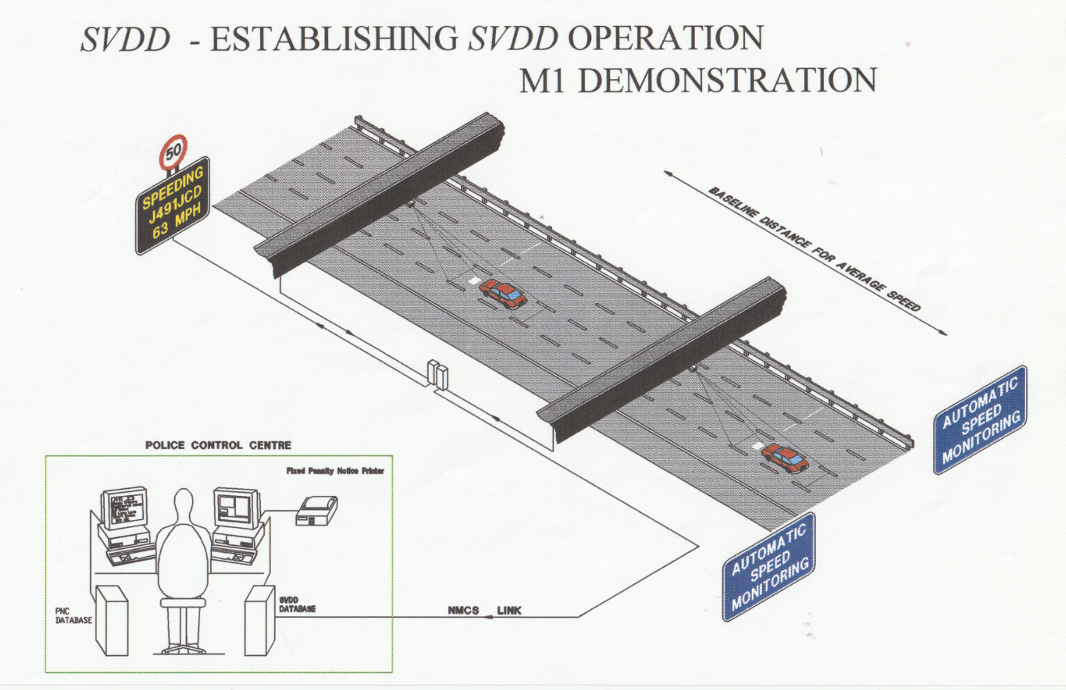
The deployment commenced in April 1994 and concluded when the new A46/M1 junction became operational in October that year. The system was officially launched, with significant media attention, by the then Minister for Roads, Robert Key MP.
Analysis of the data showed that average vehicle speeds reduced by 10mph and the 85th percentile speed by 12mph. Overall violation rates fell from 70% in covert mode to 30% in overt deterrent mode — without any prosecutions.
In summarising the trial, Inspector Allen of Leicestershire Constabulary wrote: “There is no doubt that SVDD is an innovative system which should, if granted the necessary Home Office Type Approval Certificate, be invaluable for use in major roadworks as a speed deterrent and also has potential for other crime and traffic applications.”
The SVDD system attracted interest from police forces across the UK and internationally. It was awarded a commendation by the 1994 National Construction Innovation Award panel in February 1995, and was nominated for the Royal Academy of Engineering MacRobert Award.
The ACPO Standing Sub-committee on Traffic Enforcement visited the working SVDD installation in July 1994 and were satisfied that the enhancements introduced since the M20 trial justified recommending to the Home Office that SVDD progress to the scientific evaluation phase of Type Approval.
Commercial development and the road to SPECS
At this stage a promoting consortium — Traffic Management & Information Services Ltd (TMIS) — was formed, adding the venture capital and data/transaction expertise of Ventura Customer Services Management to Computer Recognition Systems Ltd and Symonds Travers Morgan Ltd. The Type Approval process proved challenging and protracted: the Home Office’s Speed Meter Handbook required substantial modification to embrace digital technology, and a new Video Meter Handbook needed to be drawn up to set the Type Approval criteria.
Meanwhile, a further ANPR application began development in response to a specific and dramatic challenge: the collapse of the Heathrow Express rail tunnel beneath the airport’s Central Terminal Area in October 1994.
BAA’s plan to minimise the resulting construction delay involved creating a temporary station at Stockley Park, north of the M4 Spur to Heathrow Airport. A fleet of coaches would transport passengers between a temporary Heathrow Express rail service running from London Paddington to Stockley Park and the airport terminals — bypassing peak congestion on the Spur.
To make this work, a southbound lane widening of the M4 Spur was required to create a dedicated bus lane. Geoff Hill Infrastructure Ltd (GHI Ltd) was contracted by BAA to project-manage the scheme, which ran from autumn 1996 to August 1997. An essential element was to provide operational surveillance and control for the Heathrow Star Centre, the traffic management control centre monitoring roads in and around the airport.
GHI Ltd brought together CRS and NEI Control Systems to deliver a bus lane violation detection and deterrent system, over-height vehicle detection, general traffic messaging via VMS, and traffic signals to prioritise coaches into the airport tunnel. The bus lane system deployed cameras to detect vehicle size; vehicles not conforming to the coach profile had their number plate read and displayed on a deterrent gantry-mounted VMS at the end of the bus lane.
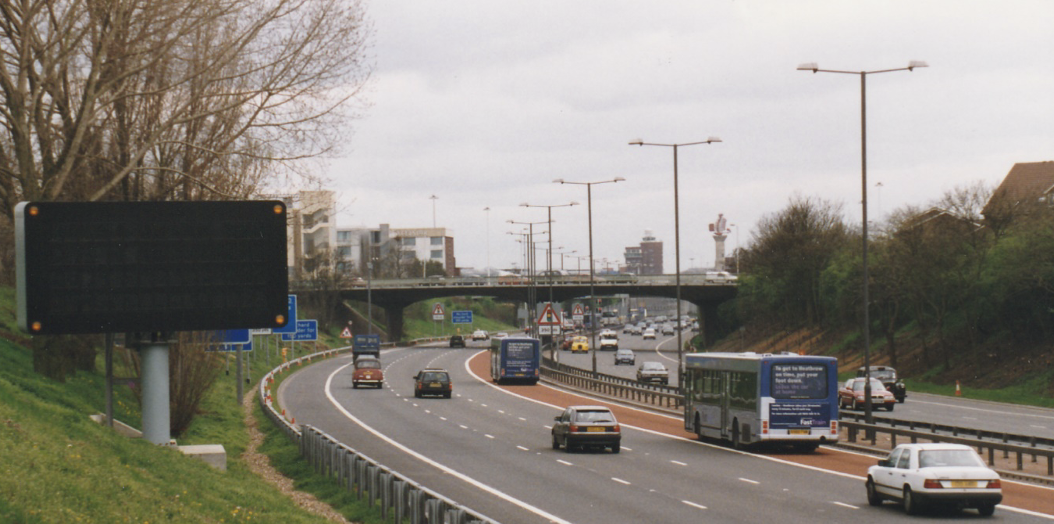
This system had no Home Office Type Approval but, as with the motorway SVDD trials, proved successful in deterring unauthorised vehicles from using the dedicated lane. The violation detection system was kept in place after the Heathrow Express service was able to run direct from Paddington into the airport station following completion of the tunnel collapse rectification — continuing to allow public transport buses and coaches to bypass peak-hour congestion on the inbound M4 Spur.
The technology comes of age
The extended duration of the Home Office Type Approval process ultimately led to the break-up of the TMIS consortium. The SVDD concept of average speed enforcement finally found its first Type-Approved deployment on the UK highway network in 1999, when Speed Check Services Ltd launched SPECS — with the first operational installation on the A6514 ring road in Nottingham in 2000. Further deployments followed on motorway widening schemes on the M25, M1 and M6, where SPECS2 technology was deployed in enforcement mode incorporating digital networking and longer enforcement baseline distances, with the VMS deterrent element having been discontinued. Major reductions in speeding and traffic accident rates were achieved.
In 2003, ANPR technology was deployed to deliver the Transport for London Congestion Charging scheme. In 2009 SPECS3 was introduced, facilitating bus lane enforcement, and in 2015 a level crossing enforcement system became active in the UK under the Vector brand.
In 2010, SPECS — backed by LDC equity — acquired CRS, and ongoing ANPR applications continued under the rebranded Vysionics name. The company became a major UK provider of ANPR-based enforcement systems, including average speed cameras, journey time systems, and police and rail enforcement technologies. LDC sold their equity stake in 2014, resulting in the acquisition of Vysionics by Jenoptik, the German global technology group.