

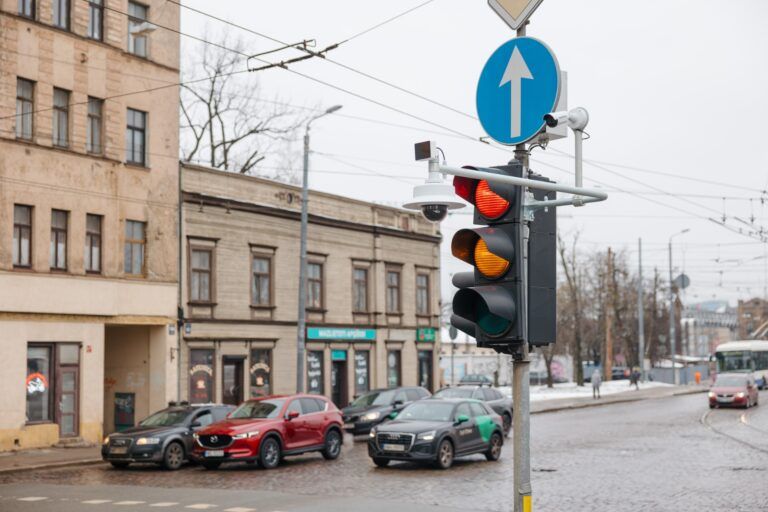
Data from LMT Group’s traffic monitoring solution in Riga shows that red-light violations in Latvia’s capital have dropped by 66% over the past six months since the system was installed across nine locations. After peaking at 3,636 violations in August 2025, the number declined steadily through autumn and winter, reaching 1,134 in February 2026.
Before LMT’s solution was rolled out in March 2025, Riga Municipal Police issued 1,250 red-light violation tickets across the entire city in 2024 through manual patrols – a figure that illustrates the scale of improvement offered by automated monitoring, while also reducing strain on enforcement resources.
The data has also revealed that Riga’s riskiest hour for red-light violations falls between 4pm and 5pm, rather than later in the evening rush. By comparison, the number of violations during the morning commute is half as high.
“Smart control systems have become an indispensable tool for organizing the city’s circulatory system – the traffic flow – preventing the intentional creation of congestion and ensuring priority for public transport. The goal of technology is not to punish, but to instill self-discipline: we see that precise monitoring of speed limits, red lights, and traffic lanes helps create a safer and more predictable environment for every road user and even saves lives,” says Andrejs Aronovs, deputy chief of the Riga Municipal Police.
According to European Commission data, 19,400 people lost their lives in road accidents in Europe in 2025, while Latvia ranked fourth in the EU for road fatalities. Although the total number of fatal accidents fell by 3% in 2025, Europe has still not achieved its Vision Zero goal of eliminating road deaths.
“Transport monitoring is not only an enforcement tool – it is also a way to make cities safer through data. Road fatalities remain a serious challenge across Europe, and Latvia is no exception. Solutions such as ours help authorities respond more effectively, while also giving city planners the evidence they need to improve infrastructure and reduce risks for everyone on the road,” says Gints Jakovels, computer vision and mobility solutions manager at LMT Group.
LMT’s traffic monitoring solution includes a range of capabilities such as detecting and classifying objects, tracking their movement, recognising vehicle licence plates and identifying traffic light signals. In addition to red-light violations, the system can detect illegal use of bus lanes and unlawful stopping at intersections. When a potential violation is detected, the system forwards the relevant information to Riga Municipal Police and the Road Traffic Safety Directorate (CSDD), which assesses the incident and determines the penalty.
Beyond enforcement, the solution provides statistical analytics. By monitoring traffic flows and movement patterns, urban planners can identify where infrastructure upgrades – such as traffic lights or crossings – are needed, replacing estimates with real-world evidence.
The LMT traffic monitoring solution is installed in six cities in Latvia, serving over 800,000 inhabitants. Latvia’s entire fleet of 360-degree police camera cars recorded 740 red-light violations in 2024, while LMT’s solution at a single intersection detected six times that number over six months. The solution is also used by the city of Graz in Austria.
Image: LMT Group