


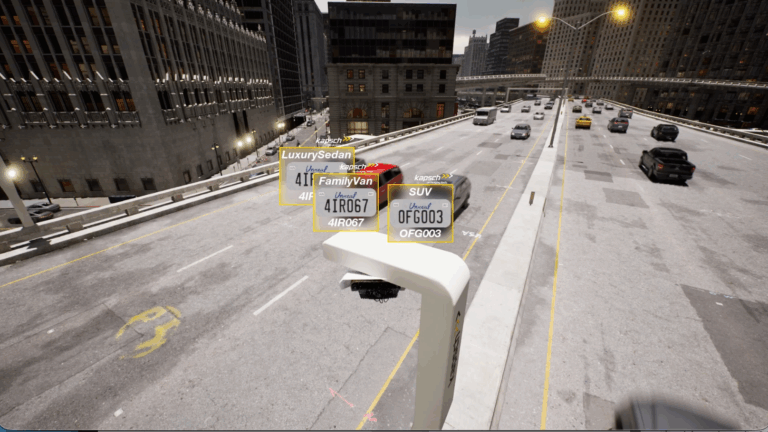
Kapsch TrafficCom used Intertraffic Amsterdam 2026 last week to make the world premiere of HoTCap, an AI-based vehicle fingerprinting technology designed to close the revenue gap that persists even in well-performing tolling systems.
The system – whose name stands for Holistic Toll Capture – works by creating a unique fingerprint from a vehicle’s overall shape and characteristics, rather than relying solely on licence plate recognition. Even where a plate is partially obscured, incorrectly read, or captured only in fragments across multiple cameras, HoTCap’s AI algorithms can compile a complete transactional record with a high degree of confidence.

Speaking exclsuively to TTi Samuel Kapsch, COO of Kapsch TrafficCom, described the core principle: “Even if the licence plate is partially covered while a vehicle is driving on the highway and you otherwise couldn’t create a secure transaction in the classic tolling system, [HoTCap allows you to] prove that this vehicle was, in fact, here via the fingerprint — and then actually generate the transaction, thereby improving the collection for our customers.”

Markus Russold, VP global sales enablement tolling at Kapsch TrafficCom, walked through a real-world scenario during his Intertraffic presentation to illustrate how the AI builds up its picture across a journey. As a vehicle passes through a series of cameras, each capture contributes to the fingerprint — even imperfect ones. In his example, a first camera reads a plate but with low confidence on one character; a second captures the vehicle while partially occluded; a third is blocked entirely by another vehicle; and a fourth delivers a cleaner capture. The AI synthesises all of these data points into a single, reliable transactional record. “All of these captures make up a fingerprint,” Russold said, “the all-important enabling technology.”

A key feature of HoTCap is that it is designed not as a replacement for existing tolling infrastructure but as an AI-powered layer that sits on top of it, enhancing what is already there. As Russold explained: “Tolling systems work perfectly well today. They are reliable, they are accurate. Still, there is a gap — it’s never really 100% perfect. With HoTCap, we aim to reduce that gap in order to reduce operational expenditure for our clients and to enable light infrastructure deployments.”
The system is hardware agnostic, working with existing camera installations — gantry-mounted or pole-based — and can mix and match the two, protecting previous infrastructure investment while improving overall performance. For operators building new systems from scratch, it also offers a lower-cost deployment path from day one.

Because cameras positioned at non-standard angles inevitably produce degraded licence plate reads, HoTCap’s AI-driven approach of analysing whole-vehicle features makes it particularly well suited to these lighter, more flexible deployments. Russold noted that the technology assesses overall vehicle shape and colour rather than specific identifiers such as scratches or damage, delivering consistent performance across both new and older vehicles.
Kapsch TrafficCom confirmed that Intertraffic Amsterdam marks the first public announcement of HoTCap, with no prior press release having been issued ahead of the show.
Samuel Kapsch positioned the launch within the company’s broader strategic direction around infrastructure-light tolling: “Any infrastructure that you can remove is a good thing — lower maintenance costs, lower risk. And you’re really leveraging technology itself and trusting in the algorithms.”