


After years of controversy and false starts 2025 finally saw New York City implement congestion tolling across the lower half of Manhattan. It reached its first anniversary of operation on 5 January 2026 with success reported on all fronts, which was recognised with three IBTTA awards. Christopher Court-Dobson talks with the experts who oversee the scheme and digs deeper into the technology that makes it work
When New York City’s Congestion Relief Zone launched on 5 January 2025, critics warned it would damage the economy and burden working families. Twelve months later, the data tells a very different story.
Governor Kathy Hochul marked the programme’s first anniversary by announcing it had exceeded expectations on almost every measure: 27 million fewer vehicles entered the zone in 2025 compared with the previous year, while revenue reached US$550m – some US$50m above projections.
The environmental gains have been striking. A Cornell University study published in December found that fine particulate pollution (PM2.5) within the zone had fallen by 22% during the programme’s first six months – a greater reduction than seen in either London or Stockholm’s congestion schemes. Traffic-related fatalities across New York City reached historic lows, down 19% year on year, while crashes within the zone fell 7%.
11% The increase in journey speeds since the implementation of NYC’s Congestion Relief Zone, with 27 million fewer vehicles entering the zone in 2025 compared to the previous year
Meanwhile, fears of economic harm proved unfounded: Broadway ticket sales rose 23%, office leasing hit its highest level since 2002, and storefront vacancy rates declined. The programme has survived repeated legal challenges and ongoing opposition from the Trump administration, with a preliminary injunction keeping it operational pending further proceedings.
For the transportation technology sector, the scheme represents both vindication and a blueprint – proof that politically fraught urban tolling can deliver measurable benefits when backed by robust technology and sustained political will.

Even before the first year’s data was in, the success of the scheme was clear and tolling awards were won. “The IBTTA awarded three separate recognitions for this project,” says Allison de Cerreño, CEO of the Metropolitan Transportation Authority Bridges and Tunnels (MTA B&T), which oversees the scheme. “Two went to MTA, including the President’s Award, and the third went to TransCore for their role in delivering the system.”
These awards speak to system-level performance improvement: congestion reduction, behavioral change, and public benefit. “It’s the combined impact of reducing congestion and generating revenue to support transit,” says de Cerreño. “It wasn’t about one technical element, it was the system working as a whole.”
Future proofing and scalability
Designing the CRZ was not just about making something that worked on day one; it was about building something that would still work 10, 20, even 30 years from now.
“We had to minimize the physical footprint, use existing infrastructure wherever possible, ground the system in what people already knew, and make it future-ready,” says de Cerreño. “Future-proofing meant designing a tolling ecosystem that other identification technologies could plug into later.”
There was also the human layer. Rather than reinvent the customer experience, the system was deliberately integrated into platforms people already understood. “We integrated the new roadside system into the existing back office so that customers experience something familiar – E-ZPass and tollsby- mail – even though the underlying concept of congestion pricing is new,” says de Cerreño. “Tolling is always political. When the program was announced, support dropped – and that’s completely consistent with international experience. After implementation, support rose as the benefits became visible.”
Today, the narrative has shifted. The question is no longer whether the system will work, but how its results will shape the future of the city’s street management.
12% The increase in bus ridership in Manhattan since the implementation of the CRZ, with subway travel up 7%
“What’s notable now is the alignment of government, media, academic researchers, and private analysts who are all saying the same thing: the program is working,” says de Cerreño.
The policy roots of the CRZ extend back much further than the current moment, with the idea for congestion pricing in New York going back to the early 2000s. But the decisive shift from planning to execution came with the legislative authority, granted by the Traffic Mobility Act in 2019. The law ensures that revenue is channeled directly into improving the very systems that make the city accessible and mobile.
“All of the net revenue goes to transit,” says de Cerreño. “80% to subways and buses, and the remaining 20% split between the commuter railroads. That’s written into the law.”
The effects are now visible not just in modeling reports, but in daily experience: shorter bus travel times, clearer intersections, more predictable journeys.“The congestion reduction is measurable, and people can feel it,” says de Cerreño. “That matters. Lived experience validates the data.”
Political challenges were in plentiful supply, US Federal Highway Administration (FHWA) — which, at the time, sat under the Trump administration’s Department of Transportation, led by Elaine Chao, refused to make a decision on which sort of environmental approval the CRZ needed. The legal limbo was widely seen as purposeful slow-rolling, with Donald Trump setting a hostile tone towards New York and promising to kill the CRZ. He encouraged lawsuits, railed against it in rallies, and framed it as “punishing workers” and a “money grab”, despite the extra income being an overall boon to the city. Now its architects appear vindicated as the project is popular, lauded and successful.
Neural networking
Despite being a system of many parts, there is a core, cutting-edge technology that allows the system to operate accurately across the shifting complexity of Manhattan’s streets. “Neural networks are at the core of the system,” says Sergio Reis, VP for Tolling Operations at MTA B&T. “They confirm vehicle class, perform ALPR, and apply business rules and improve accuracy.”
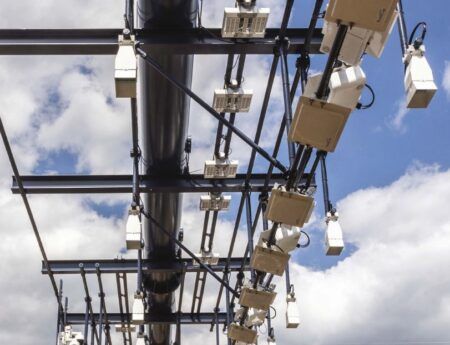
Each site must read a vehicle under chaotic conditions that may change moment-to-moment. The hardware is therefore arranged in coordinated arrays, with each device performing a specific interpretive task. “It’s an edgecomputing, vision-based tolling system.
The detection, classification, and a significant portion of processing all happen at the roadside,” says Reis. “Each roadside installation includes multiple cameras. Some classify the vehicle profile; others perform license plate recognition. The system dynamically adapts to lane shifts and street conditions, which is essential in an urban environment.”
$550m The first-year earnings for the CRZ. $50m more than predicted. All profits will be invested in transit
Crucially, it’s a feedback loop that builds memory. The first time an image set needs human eyes, the outcome isn’t thrown away, it seeds a persistent profile that streamlines all subsequent passes of the same vehicle. “We generate a unique vehicle identifier after the first manual review,” says Reis. “From then on, the system recognizes that vehicle and avoids repeating the manual process, improving efficiency and accuracy.”
But no urban dataset is perfectly tidy. Weather, angle, debris, or an unusual load can push a reading outside expected bounds. “If something about a detected vehicle falls outside defined parameters, the system automatically sends it back for human review. That’s how we maintain reliability at scale,” he says.
The other hard problem is geographic logic: distinguishing those merely skirting Manhattan on exempt arterials from those actually consuming scarce street capacity within the cordon.“That is where the algorithms do the heavy lifting,” says Reis.
But technical functionality was only half the challenge. The equipment had to exist in a city whose streets are already saturated with infrastructure, signage, and visual noise, meaning it needed to do its work without announcing itself.
“The equipment reads transponders and Bluetooth, with infrared illumination that avoids flashing and light pollution,” says Reis, “It blends into the streetscape.”
The environmental constraints of New York also dictated how the hardware handles heat, energy, and maintenance. “We designed it so that everything operates on ambient cooling,” he says. “No external refrigeration was required, which cuts power consumption to about 20% of a standard tolling setup.”
EQUITY – MINDED PRICING
Workers are the life-blood of the city, and pricing them out can only ever lead to chaos. Those on incomes under $60K qualify for discounts under a tax credit system if they live inside the CRZ. Separately, New York’s Low-Income Discount Plan cuts the peak CRZ toll by 50% after a driver’s first 10 trips in a calendar month for those on lower incomes. Together, the tax credit and the trip-based discount are designed to keep essential commutes viable while still managing demand.
Across other US cities, equity-minded pricing is becoming the template. Los Angeles, Seattle and Chicago have each examined congestion pricing frameworks that explicitly contemplate discounts for low-income drivers. While program details differ and timelines vary, the underlying principle is converging effective pricing must protect those who keep the city running.
This article is updated from the feature that first appeared in the November 2025 edition of TTi magazine