


Pennsylvania Turnpike’s move to open road tolling is a leading light for the industry. As the award-winning project nears its conclusion Tom Stone talks to the people who helped to wave goodbye to nearly 90 years of toll plaza payments. They set out the challenges of implementation, explain how they overcame them, and highlight the benefits they are now seeing
The wide open freeway, the wind in your hair… Over the past century the US has been built around the seemingly endless possibilities presented by motorised vehicles and roads. What this dream never really mentioned was traffic jams and toll plazas – literal road blocks and inconvenient truths that somewhat marred the dream of unrestricted travel. But in January 2027 Pennsylvania Turnpike (the USA’s first modern toll road, opened in 1940) will be a step closer to that dream as every one of its 565 miles will by then be running with open road tolling (ORT). The last toll plazas east of Reading are already coming down; the final gantries west of Reading are going up; and the entire scheme is currently on schedule for a first-Sunday-in-January switch-on.
Alan Williamson, construction engineering manager for the turnpike, has spent close to a decade overseeing the plaza adaptations and demolition, often on a vast scale. “Some of our plazas in the Philadelphia area were 21 lanes wide,” he says. “Demolishing them while maintaining normal flow was a big challenge.”
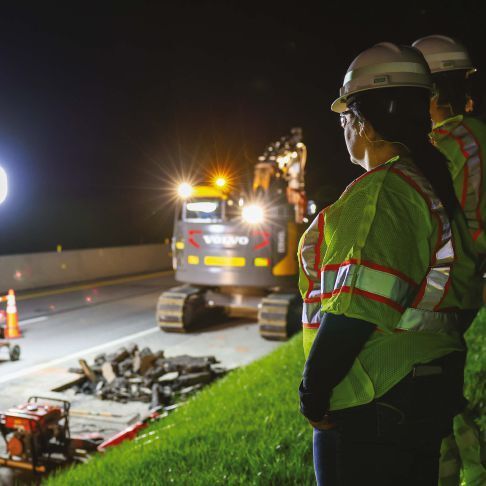
Where work can’t happen around live traffic, Williamson’s teams reach for one of two tools. “If we’re doing active work overhead, over a live lane, that’s when we’d invoke what we call Plan X – our term for a shutdown or detour of an interchange,” he says. Usually these run overnight in a five-to-six-hour window of operation.
For smaller jobs, like lifting a new gantry beam into place, there’s a lighter touch. “Instead of a full detour we’ll run what’s called a traffic pace, coordinating with state police,” says Williamson. “At the right location they’ll get in front of customers and slow them to 20-25mph, still moving rather than stopped, to give the contractor enough of a gap to lift the piece into place and secure it.”
The traffic pace is also used when rock blasting is necessary in Pennsylvania’s hill country: “We sweep up any debris reaching the roadway quickly, and reopen, usually within less than 20 minutes,” says Williamson
Demolished plazas leave the Turnpike sitting on land it built up over decades, much of it shaped for the old trumpet interchange loop layout. “Some areas we’ve demolished, removed all appearance of the old infrastructure, and returned to grass or meadow, so its no longer a stormwater runoff, giving us environmental benefit,” says Williamson. “In other locations we haven’t dug it up yet, because we’re not certain whether leaving the concrete in place might serve some future purpose.”
What ORT does remove for good is the geometric constraint that shaped every interchange built since the 1940s: “One of the flexibilities ORT offers is that we no longer need the old trumpet-style interchanges to get people on and off the system,” says Williamson. “It can instead be a diamond-style interchange, with a traffic signal and turns left or right, rather than the full loop configuration.”
Sensor fusion
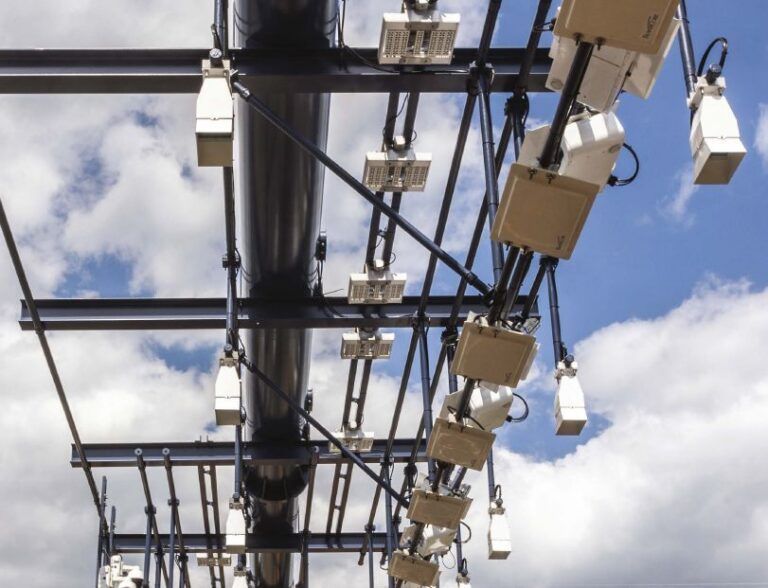
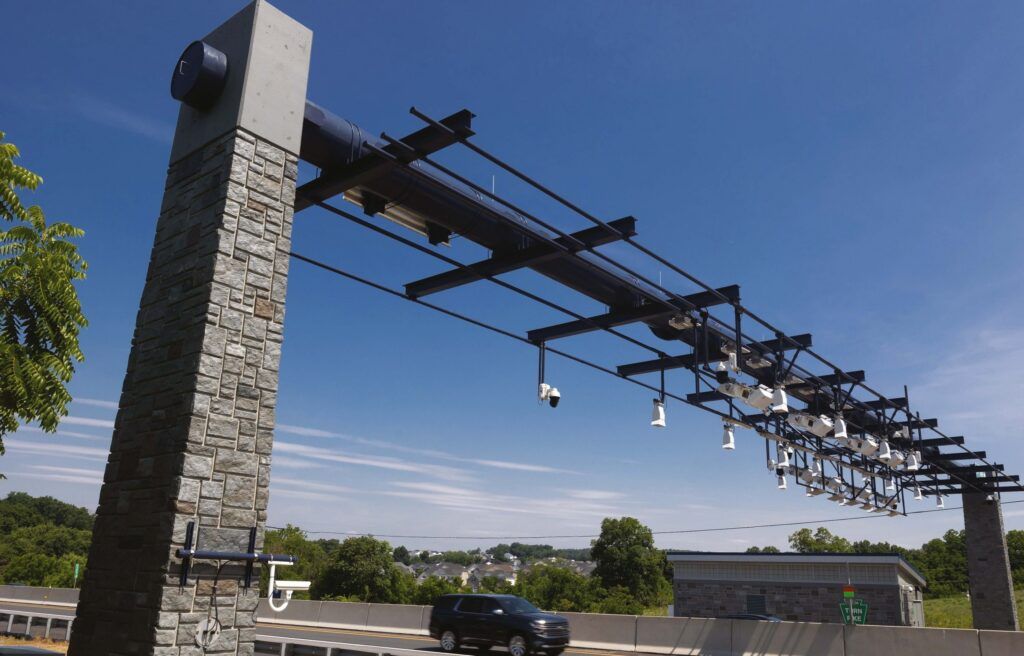
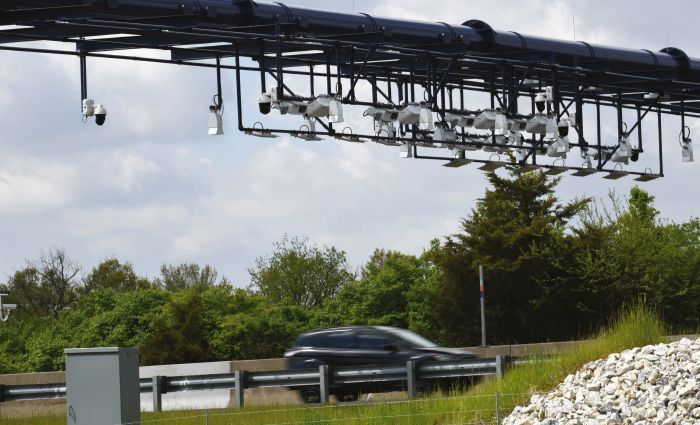
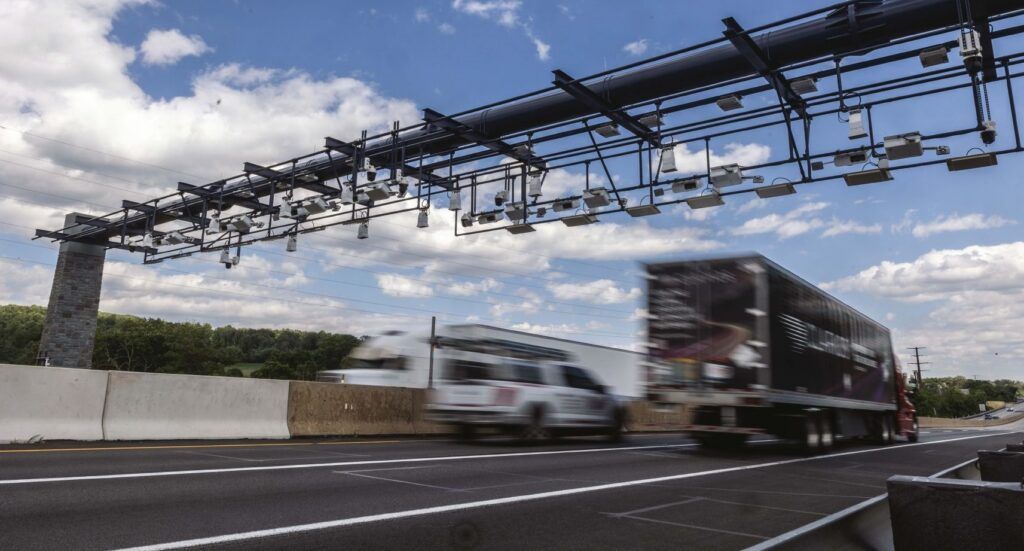
Each ORT gantry incorporates tag readers, video detection and lidar sensors, while in the roadway beneath two types of inductive loops are embedded. The sensor fusion can distinguish one vehicle from the next at 70mph, with redundancy built in.
“Multiple things go into making up a transaction when a vehicle goes under a gantry. Everything is based on timing,” says Matt McConnell, ETC project manager at PA Turnpike Commission. The first set of loops picks up the metal mass of a vehicle and trigger the overhead cameras that capture front and rear plates; a second set of loops counts axles.
“With ORT we no longer need the old trumpet-style interchanges”
Alan Williamson, construction engineering manager, PA Turnpike Commission

With the introduction of ORT the turnpike has dropped weight as a factor in tolling. “We’ve switched to axles and height,” says McConnell. Lidar measures vehicle height at the same time the loops count axles, sorting traffic into 11 classes: five low (under 7ft 6in) and six high. A dedicated antenna over each lane also reads E-ZPass transponders.
Redundancy is built in. “We have multiple cameras in each of our units. So, if one fails, we have a backup unit,” says McConnell. “We also have two sets of axle-counting loops – one as a backup. These gradient loops consist of multiple overlapping loops whose primary purpose is to detect the metallic content in wheels that are in contact with the ground, which translates into an axle count.”
One particular challenge in open-road tolling using loops is differentiating close-following vehicles. “You could have a vehicle that is on the exit point of a loop while a vehicle is also right behind, close following, on the entry point of the loop,” says McConnell. “That’s where the overhead scanner will help to see and differentiate between the two vehicles.”
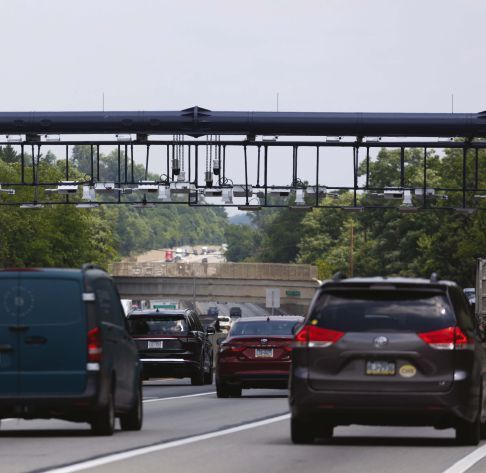
The sensor fusion creates a highly robust system. While traditional RFID E-ZPass tags are read at a success rate of around 93% in ORT (high speeds mean the system is extra sensitive to the correct windshield mounting), almost every vehicle is accurately recorded in some way. “We pick up 99.9% of vehicles on our lanes now,” says McConnell, with plate cameras firing for every vehicle regardless of whether a tag is read.
Those without an E-ZPass pay around double the tolls, reflecting the additional back-office cost in administrating toll-by-plate billing and revenue collection.
The robustness of the system is further secured by roadside data-storage capacity. “We store all our transactions at our lanes for 90 days… in the event that something happens or some corruption happens [during the transmission of data], we have the ability to go back and recreate that transaction and send it across,” says McConnell.
“We’re picking up 99.9% of the vehicles that travel through our lanes now”
Matt McConnell, manager of toll systems technologies, PA Turnpike

Williamson puts the split between civil works and technology at each ORT site at roughly two-thirds to one-third. “There’s a building beside each gantry,” he says. “Half of it is just a backup generator, in case of a power loss at that location. The other half I always loosely call the brain of the transaction zone, like our own brains, where all our senses feed in.”
Transcore supplies the tag readers and peripherals, while the Turnpike’s own fibre backbone, laid in alongside the gantries, carries the data back to Harrisburg. It replaces legacy microwave communications that wouldn’t have been capable of handling the data load.
While fibre is expensive, the commission has been smart in diversifying its income by laying additional capacity, which it is leasing out to local businesses. “That’s additional revenue that doesn’t have to come from our tolling customers,” says Williamson.
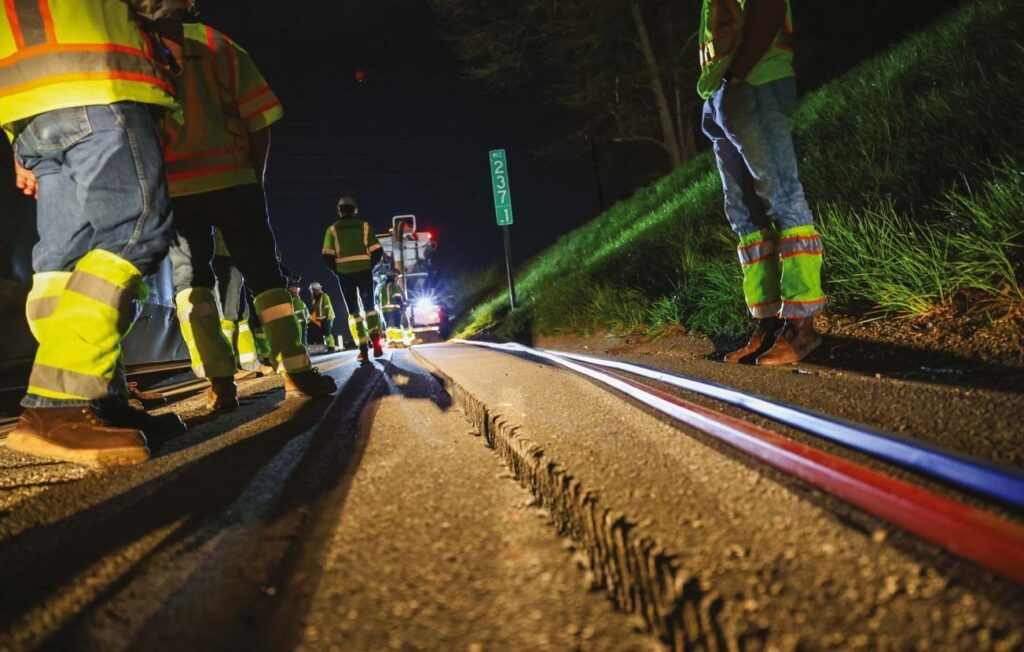
Security is built into the same fibre communications. “It’s all encrypted,” says McConnell. “We are not sending data across the internet, so this can all be firewalled in our own network.”
While the move to ORT has been a gargantuan effort for the Turnpike Commission, for customers, McConnell is at pains to stress, the transition needed no action at all: “There’s been no requirement for our customers to change the way they do anything. You didn’t have to re-register to use ORT.”
Some customers may, however, notice a difference in their regular bills, with rates being standardised for the first time in the system’s history. “The rates were not consistent per-mile across the system, because the rate for each interchange was initially based off of how we were repaying the bonds, for when the turnpike was being built, back in the day,” explains PA Turnpike Commission’s assistant press secretary Crispin Havener. Moving to axle-based classification and ORT was the opportunity to fix that. “There’s a rate per mile plus a segment fee for every time you cross a gantry.”
Standardised per-mile rates on the turnpike bring to mind schemes looking to apply a distance-based charge across all road types, in order to plug the gap in falling revenue from fuel taxes, often known as road user charging (RUC). Could it be that one day travel on the turnpike will be simply a higher per-mile rate than on other roads? Such a future would require something even more advanced than ORT, and both engineers agree that ORT is a staging post rather than an endpoint.
“There has been some mild success with things like satellite or GPS tolling,” says Williamson. “As the vehicle industry evolves with connected vehicles, could the fibre become useful through some kind of wireless connectivity, a generation or more into the future? Could a car communicate wirelessly through our fibre line, and have its toll charged just by us recognising it on our system? I liken it to air traffic control: a plane enters a space, air traffic command makes contact, and either communicates directly or there’s a transponder that helps navigate the rest of the way.” For now, that stays firmly on the horizon; the near-term work is finishing what’s already under construction.
The finish line approaches
The finished ORT system will have 38 ORT stations statewide, split evenly between east and west. Sixteen of the 19 western sites are already tested and commissioned and waiting for the switch-over. As the western rollout nears its conclusion McConnell reflects on how smooth the process has been: “We took the lessons we learned from the east and the northeast and transitioned those over into the central and west install. We had a much clearer plan and process in place for making sure that we had all the equipment ready ahead of time.
“We are down to the final three installation sites now… those are scheduled to be done by October, which gives us a nice window to evaluate the data from those sites before we go live.” Williamson, who led the original cash-to electronic conversion, is now proud to be finishing the system that evolved from that. “Since I was at the very front end of this job, it kind of feels like this is my legacy moment,” he says. “I’ve left my fingerprint in the history of a fabulous organisation to work for.”
By 2029, once the central and western plazas have followed the eastern ones in being demolished, and with the Turnpike itself turning 90 in October 2030, the image most drivers carry of getting on or off it will belong to a different era altogether.
AET vs ORT
All-electronic tolling (AET) and open road tolling (ORT) both do away with cash, but they’re not the same thing. AET-in-place, which the Pennsylvania Turnpike rolled out system-wide from 2020, still ran transactions through the footprint of a conventional plaza: E-ZPass and plate-reading equipment bolted onto the old channelised lanes, with customers slowing down to pass through them. ORT removes the plaza altogether.
Overhead gantries positioned between interchanges, rather than at them, read vehicles at highway speed, so there’s no channelisation, no slow lane, and, eventually, no structure in the roadway at all. “All-electronic can be an open-road format, or it could be what we used to call AET-in-place,” says Williamson. “It just falls under all-electronic tolling; it’s just a way of performing the transactions.”
OPEN ROAD TIMELINE
March 2020 The Turnpike converts system-wide to allelectronic tolling (AET), ending cash collection.
2021-22 Overhead lidar scanners begin replacing ground-level separation equipment on legacy lanes, partly to keep the equipment out of the path of wide loads.
2023-24 ORT stations are built across the east and northeast, with Transcore equipment installed and tested.
5 January 2025 ORT goes live east of the Reading interchange and on the entire Northeast Extension.
2025-26 Legacy plaza demolition proceeds in the east while gantry construction moves through central Pennsylvania and out to the Ohio line.
Oct 2026 The final three of 38 planned ORT stations statewide (19 east, 19 west) are planned to complete installation.
First Sunday, January 2027 ORT launches statewide, completing the system from the Reading interchange to the Ohio line.
2027 onward Four contracts go out to demolish the remaining legacy plazas in the central and western regions.
2029 Plaza demolition is expected to be largely complete system-wide.
All images ©PA Turnpike
This article was first published in the October 2026 edition of TTi magazine