



Swiss measurement technology specialist Kistler will debut its first fully digital Structural Health Monitoring (SHM) system for bridges at Intertraffic Amsterdam in March.
The system, which will be displayed at hall 1, booth 410 from 10-13 March, replaces traditional analog monitoring technology with a modular digital architecture designed to give infrastructure operators real-time visibility into bridge condition.
At the core of the solution are digital sensors organised in flexible clusters that can be configured in daisy chain or star topologies. This modular approach allows the system to adapt to different bridge geometries while reducing cabling requirements, according to Winterthur-based Kistler.
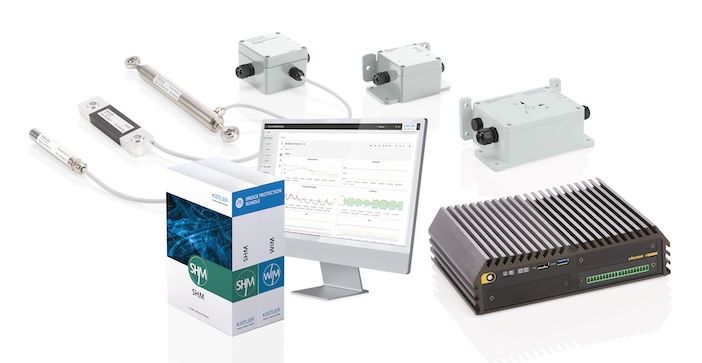
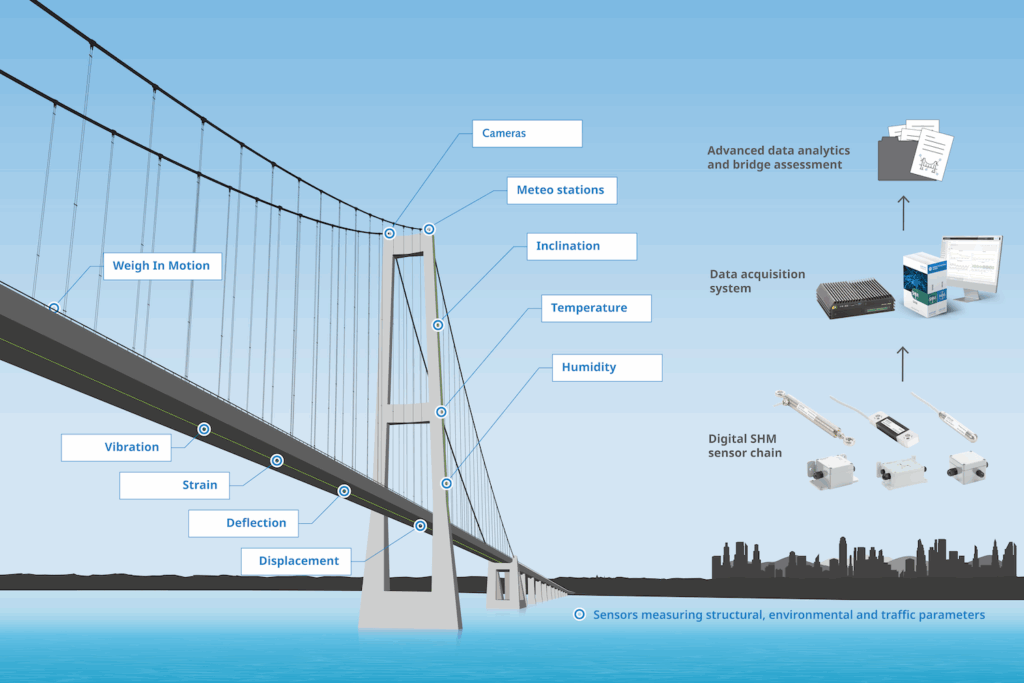
The sensors continuously measure strain, displacement, cracks, vibration, inclination and temperature. All sensor clusters are synchronised within microseconds to ensure time alignment across channels. Open interfaces allow operators to add custom sensors where needed.
The sensors feature weatherproof housings with electromagnetic interference immunity. Self-configuring digital technology reduces setup time and minimises manual adjustments during installation.
Integration with weigh-in-motion
The SHM system can be combined with Kistler’s weigh-in-motion (WIM) technology for active bridge protection. WIM systems installed upstream of bridges measure traffic loads and identify overloaded vehicles, which can be automatically fined or prevented from crossing.
Both SHM and WIM data streams are processed by a dedicated edge device, enabling operators to correlate traffic loads directly with structural impact. The system supports time- and event-based triggers plus automatic alarms when sensor readings exceed set thresholds.
Deployments worldwide
Kistler points to several reference projects demonstrating the technology. At Washington Bridge in Providence, Rhode Island, an integrated WIM and SHM solution supports restoration work on the historic structure. Engineers correlate traffic data with vibration, strain and movement measurements to derive site-specific load ratings based on actual conditions rather than conservative estimates.
WIM technology is deployed on the Sultan Abdul Halim Muadzam Shah Bridge (Penang Second Bridge) in Malaysia, a 24km crossing between mainland Malaysia and Penang Island. The system monitors vehicle loads and traffic patterns to support long-term operation and maintenance.
On the 1915 Çanakkale Bridge in Turkey, multiple Kistler WIM sensing lanes provide continuous insights into live traffic loads. The data supports fatigue assessments, service life predictions and site-specific load ratings.