


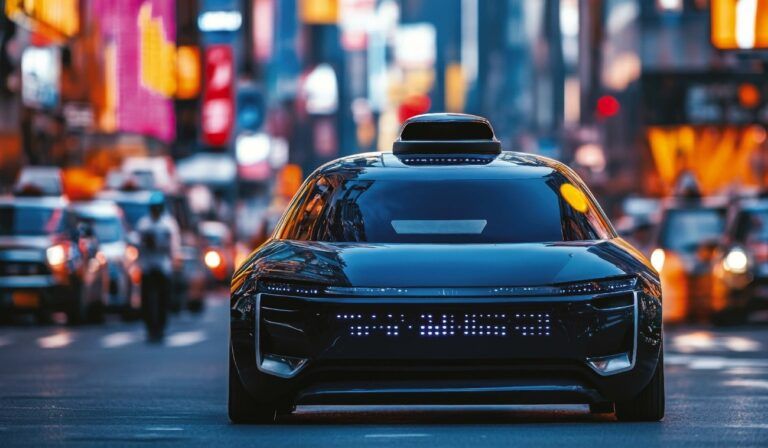
London is ready to become Europe’s first proving ground for driverless taxi services in 2026 as Waymo and Moove, a partnership that has already been successful in the US, join both Uber and Lyft in planning pilots in the capital in the coming months. But what challenges will they face?
Waymo has announced it is to bring its driverless ride-hailing service to London through an expanded partnership with global mobility company Moove, positioning the capital as a key battleground in the race to deploy autonomous taxis across Europe.
The planned rollout places Waymo in direct competition with rivals Uber and Lyft, both of which are preparing to launch their own autonomous taxi trials in the UK capital.
“I’m delighted that Waymo intends to bring their services to London,” said UK Transport Secretary Heidi Alexander. “Boosting the AV sector will increase accessible transport options and bring jobs, investment and opportunities to the UK.”
Moove has already worked with Waymo on its robotaxi pilots in the United States – in cities including Los Angeles and San Francisco – however, deployment in the UK will present its own regulatory and practical hurdles.
“This marks the start of a new era, one where safe, efficient, and sustainable travel becomes part of everyday life”
Ladi Delano, co-founder and co-CEO, Moove

The pilots will be conducted under the Automated Vehicles Act 2024, which establishes a legal framework for the public use of self-driving vehicles. However, Professor Nick Reed, an expert in the field who worked on London’s GATEway autonomous shuttle pilot in 2018, points out that the legislation does not guarantee full rollout until certain, still somewhat nebulous, safety standards are met, with no tried legal mechanism for this.
“The legislation states that automated vehicles deployed on British roads must be at least as safe as a careful and competent human driver and that road safety should improve as a result of their deployment,” says Reed. “The challenge here for both regulators and AV developers is how they prove that these conditions have been met. This is especially difficult given the relative rarity of road collisions and the difficulty in statistically proving safety based on miles driven.”
In an effort to prove safety Waymo has already logged over 100 million fully autonomous miles on US roads and provided more than 10 million paid rides. During these journeys Waymo says it vehicles have been involved in five times fewer injury-causing collisions overall and 12 times fewer when involving pedestrians, compared to human drivers.
The company’s data has attracted support despite public skepticism (see Public trust issues above). “Autonomous vehicles, such as Waymo, hold the potential to significantly improve road safety because, quite simply, the human driver is removed,” says James Gibson, executive director of Road Safety GB.
Yet Reed cautions that proving such safety performance remains challenging: “Waymo has published a wide range of research materials that help to validate their safety claims but there are still no independent and objective assessments that we can apply to be able to evaluate the absolute or relative safety performance of AV operators today.”
“The challenge for both regulators and AV developers is how they prove that conditions have been met”
Professor Nick Reed, founder, Reed Mobility

Even if safety standards and met and proven in law, operators will still face a challenge when it comes to fitting their services into the currently regulatory framework for carrying passengers. “The deployments of AVs will be managed in part under a new Automated Passenger Services permitting scheme,” says Reed. “It will be interesting to see how existing passenger service providers respond to AV deployments under this scheme, which they may see as threatening to their business. Similarly, transport authorities will want to ensure their efforts to encourage travelers to use public transport and active travel modes are not cannibalized by robotaxi operations.”
38,000
The number of jobs it is estimated autonomous vehicles could create in the UK by 2035, adding £42bn to the economy
Beyond regulatory and public acceptance hurdles, Reed also identifies other challenges:
Operating AVs at scale creates a range of practical challenges. These include managing the safety of vehicle occupants, ensuring continuity of service in the face of the infinite variability of the driving task (and how to integrate remote support for vehicle and occupants into this), how to ensure the vehicles are clean and roadworthy every time they are deployed and how to ensure the service fits into the broader city transport ecosystem.”
Added to this, London’s streets are particularly challenging for AVs as they are made up of an intricate network of traffic configurations, narrow roads and modal mix – a far cry from the largely grid-pattern American cities where robotaxis currently operate. Nevertheless, Moove and Waymo remain predictably bullish when it comes to assessing the future of their vehicles.
“For Londoners, this marks the start of a new era, one where safe, efficient, and sustainable travel becomes part of everyday life,” says Ladi Delano, co-founder and co-CEO of Moove. How long it takes for that dream to become a reality, remains to be seen.
Public trust issues
AVs face significant public acceptance hurdles in the UK. Recent surveys reveal widespread skepticism about the technology, with only 3% of Britons expressing high confidence in driverless taxis. In a July 2025 survey just 11% of respondents said they would use a driverless car, while 34% said they would not feel safe riding in one. More than a quarter (26%) believed driverless cars would never be as safe as humans.
Another study revealed that 66% of Britons hold a negative opinion AVs, while 84% said they would not buy one. Safety concerns topped the list of deterrents (nearly 25%) followed by worries about technical failures (18%) and concerns about losing control (17%). Nevertheless, those advocating for groups with disabilities see significant potential benefits in increasing mobility for those who cannot drive.
This feature first appeared in the November/December 2025 edition of TTi magazine