

Valerann’s AI-powered Lanternn platform fuses data from multiple road systems into a unified operational view, helping traffic authorities detect incidents, reduce alert noise and improve response times.
In August this year, five teenagers died in a collision involving a vehicle travelling the wrong way on the M9 in County Kildare in Ireland. Four people in the other vehicle were seriously injured. Later that month, seven people, including two police officers, died in a wrong-way collision on the A66 near Middlesbrough, in England. The two tragic incidents brought renewed attention to a danger that, although rare, can have devastating consequences.
The circumstances of the two collisions are distinct, and their human consequences should not be reduced to a simple lesson about road safety. For those responsible for managing roads, however, the wider challenge is a familiar one. When a dangerous situation develops, they need to recognise it, understand what is happening and decide how to respond, often with very little time.
Across a road network, cameras, traffic sensors and reports from drivers each offer part of the picture. The task for operators is to make sense of those clues quickly, whether they point to a stopped vehicle, a growing queue or another incident.
Why the picture remains fragmented
Over the years, road traffic authorities have introduced new technologies to meet particular needs, from monitoring traffic speeds to identifying vehicles and detecting incidents. Each system answers a useful question, while adding another source of information for the control room.
When those sources operate separately, the task of bringing them together falls to the control-room operator. A camera image, a change in traffic speed and a driver’s report may all concern the same incident, but that connection is not necessarily obvious. The operator must locate each observation, compare its timing and decide whether the reports support one another or describe different problems. This takes time and concentration, particularly when information is incomplete or several incidents are unfolding at once.
The difficulty is that each new source can add to that burden. More of the road becomes visible, but through another application to consult or another set of alerts to assess. Operators are left doing the work that the separate systems cannot do themselves, turning disconnected observations into an understanding of what is happening. Their ability to make those connections becomes a constraint on how much value the technology can deliver.
From fragmented information to a unified operational view
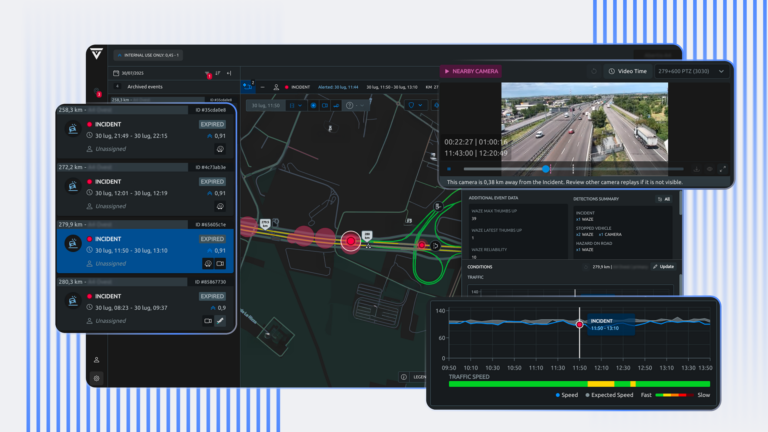
Some of that work of connecting observations can be handled by the technology itself. Valerann develops AI-powered technology to help authorities make sense of what is happening on their roads. The company’s Lanternn platform brings information from existing road systems into a single view of the network, helping operators recognise incidents and understand their significance. Using data fusion, it correlates information from different sources spatially, temporally and thematically, removes duplicates and adds context such as surrounding traffic conditions or environmental circumstances.
For example, a camera might detect a stationary vehicle while nearby sensors register slowing traffic, and a driver reports an obstruction. The camera helps explain the slowdown, while the sensors reveal its impact beyond the camera’s field of view. Lanternn can connect those observations into a single incident, assess whether it warrants an alert and present the operator with its location, supporting evidence and traffic conditions in one place.
The whole is greater than the sum of its parts
For the control room, the practical benefit is a change in the information operators have to work with. Each source already provides useful evidence, but combining it with observations from elsewhere helps establish more than any source could reveal alone. This holistic approach is central to Lanternn, helping authorities make more of their existing technology by using each source to build on what the others reveal.
Figures from a Lanternn deployment on the road network managed by Transport Infrastructure Ireland (TII) show how this process works in practice. There, some 3,500 daily source detections were processed into 56 alerts for operators per day through deduplication, data fusion and relevance assessment – a 98.5% reduction of data noise. The reported detection accuracy was 88.3%. The individual sources supplied the evidence, while Lanternn did much of the work of establishing which observations belonged together and warranted attention. “Being able to sift out the reality from the chaff across multiple sources is of huge value to us,” TII noted.
That is where the principle of the whole exceeding the sum of its parts becomes tangible. A source gains value through what it helps the others establish, while operators can devote more attention to assessing events and deciding how to respond. Valerann’s approach puts that principle into practice. Smarter roads depend on both the technologies that observe them and the intelligence that turns those observations into something people can use.
Customer feedback
An executive from the North Carolina Turnpike Authority, which is currently piloting Lanternn by Valerann, said that the platform is “an important step forward” not just in improving real-time awareness and incident detection, but for “building the foundation for where we are heading as an industry.” They added: “When you combine infrastructure data, third-party sources, and eventually connected vehicle inputs, you start to move from reacting to events to anticipating them. That is the path to safer, smarter corridors – and the pilot helps move us in that direction.”
Greek motorway concession company Nea Odos, which has deployed Lanternn by Valerann across the Ionia Odos Motorway (A5) in Greece, concluded: “The most important thing about the system is its reliability. It combines different sources of information successfully and gives alerts that operators can really trust. At the same time, it delivers them quickly, so decisions and actions can follow without delay. This helps reduce response times, improves road safety by lowering the risk of secondary accidents, and VMS messages warn drivers in time to avoid problems. Operators appreciate that the system does not send too many false alarms, and since it is always improving, its value in daily work keeps growing.”