

Opsys Technologies’ explores how modern wrong-way detection has evolved from simple 2D observation to intelligent 3D perception, combining lidar, embedded AI and solid-state reliability for accurate, scalable roadside traffic monitoring.
Wrong-way detection systems should do more than observe traffic; they should understand it. Detecting a single vehicle is relatively straightforward. Reliably identifying a wrong-way vehicle in dense traffic, adverse weather or complex roadway environments is considerably more difficult. Before generating an alarm, a system must determine where each vehicle is, how it is moving and whether its trajectory is consistent with the intended direction of travel. Those requirements have changed roadway sensing.
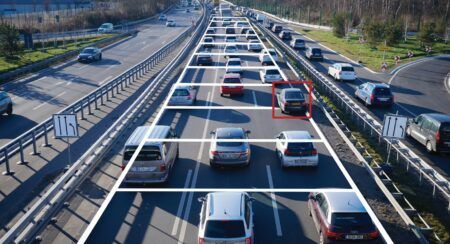
Video analytics formed the foundation of many early wrong-way detection systems. Today’s AI-powered camera systems are remarkably capable and remain a good choice for many ITS applications. The challenge is that cameras observe a two-dimensional scene. Vehicle position and movement are not measured directly but must be inferred.
Radar solved that part of the problem by directly measuring range and velocity while continuing to perform well in rain, fog and other adverse weather. In dense traffic, however, multiple closely spaced vehicles can be difficult to separate and track continuously because of radar’s lower spatial resolution.
From observation to understanding
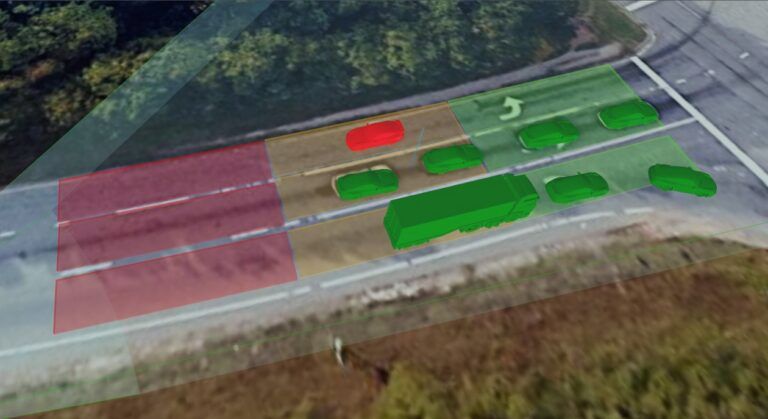
Lidar bridges the gap. It combines the camera’s resolution needed to distinguish individual vehicles with radar’s direct distance measurement. The result is a true three-dimensional understanding of the traffic scene, allowing multiple vehicles to remain distinct and continuously tracked. For wrong-way detection, that means determining not only that a vehicle is present but measuring directly whether it is travelling in the wrong direction.
Once the lidar perception problem had largely been solved, the industry encountered
a different challenge. Transportation agencies asked, “Can we deploy hundreds of these systems and expect them to operate reliably for years?” Early lidar systems solved the perception problem, but many were engineered around the sensor rather than the deployment. External processing hardware, proprietary cabling and mechanically scanning optical assemblies delivered impressive sensing performance yet were more complex and less reliable than the roadside infrastructure transportation agencies were accustomed to installing and maintaining.
Designed for deployment
The industry’s next challenge was therefore not finding a replacement for lidar, it was
making lidar practical as permanent roadside infrastructure. Transportation agencies wanted the three-dimensional understanding lidar provides together with the reliability and ease of deployment of camera- and radar-based systems. Achieving that required a new generation of lidar built around two principles: a true solid-state architecture with no moving parts for long-term reliability, and embedded intelligence that eliminates the need for external platforms.
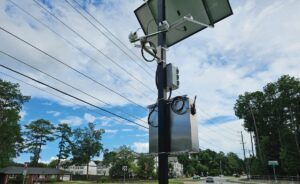
These design principles are now beginning to shape a new generation of intelligent roadside sensors. One example is the Opsys Technologies ALTOS platform. Built on a pure semiconductor architecture with no moving components, ALTOS combines high-resolution lidar with embedded perception in a single device. External analytics servers are no longer required, standard PoE simplifies installation, and a typical 10W power budget supports remote and solar-powered deployments. The ALTOS product family is also manufactured in compliance with Build America, Buy America (BABA) requirements, supporting federally funded transportation projects.
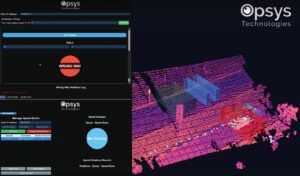
Built on the ALTOS platform, Opsys ALTOS-WAY applies the same architecture to wrong-way detection with built-in application-specific intelligence. The all-in-one intelligent roadside sensor continuously detects, tracks and classifies vehicles, analyses vehicle trajectory and generates wrong-way alerts that can be transmitted directly to existing traffic management systems.