


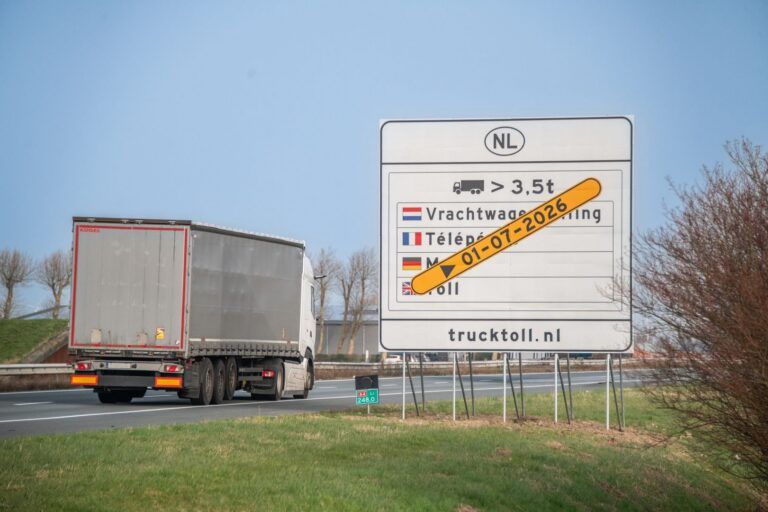
The Netherlands has introduced a distance-based truck toll from 1 July 2026, with the national vehicle authority RDW highlighting several operational differences from existing toll systems across Europe that transport operators will need to understand before entering the country.
While kilometre-based truck tolling is already established in several European countries, the Dutch system has its own requirements covering onboard units (OBUs), exemptions and payment arrangements. According to the RDW, a lack of awareness of these differences could result in fines or operational disruption.
“During our talks with foreign drivers, we noticed that they are not always fully aware of how the Dutch truck toll works,” said Jan Strijk, toll collection director at the RDW. “Transporters often assume the system is the same as in other European countries, but that is not the case. These differences can lead to unnecessary problems on the road. It is therefore important to be well prepared before entering the Netherlands.”
One of the main distinctions is that an OBU must remain always switched on while a vehicle is operating in the Netherlands, including on roads where no toll is charged. This differs from countries including Germany, Czechia, Poland, Slovakia, Hungary and Bulgaria, where OBUs are only required to be active on toll roads.
The RDW advises drivers to confirm that the device is functioning correctly before departure and that its indicator light is green, as a switched-off or malfunctioning OBU may lead to enforcement action.
The Dutch system also differs from Germany in that it does not offer a ticket option for individual or one-off journeys. Instead, every truck subject to the toll must be fitted with a working OBU supplied by an authorised service provider. The RDW has authorised six European Electronic Toll Service (EETS) providers and has also contracted national provider NedLinq.
Transport operators are advised to arrange an OBU before entering the Netherlands for the first time. Where that is not possible, NedLinq provides OBU collection points at the Dutch border after a contract has been completed online or on site. These devices are only valid for use within the Netherlands.
The truck toll applies to vehicles in the N2 and N3 categories with a technical maximum mass exceeding 3,500kg, including trucks, delivery vans and some pick-up trucks. Compared with countries such as Germany and Belgium, the Netherlands has relatively few exemptions. Exemptions are limited to specific vehicle categories, including emergency service vehicles, defence vehicles and certain specialised vehicles. Operators are encouraged to determine in advance whether a vehicle qualifies for an exemption and to complete any required application before travelling.
Zero-emission trucks are also included within the scheme if they exceed 4,250kg. Although these vehicles benefit from lower toll rates than more polluting trucks, they are not fully exempt, unlike in some neighbouring countries. Only zero-emission trucks weighing up to 4,250kg are exempt from the Dutch toll.
Revenue generated through the scheme will be reinvested in the road transport sector, including support for zero-emission vehicles and charging infrastructure as part of the country’s revenue recycling approach.