

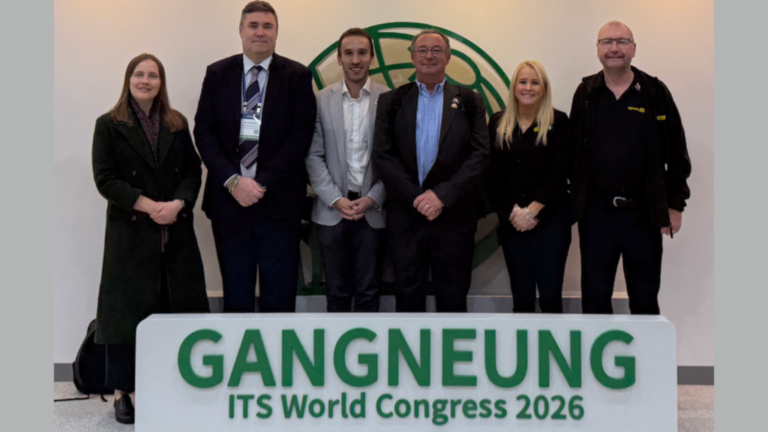
Members of the UK delegation to the 2026 ITS World Congress have visited the Urban Information Centre in host city Gangneung, South Korea, where AI links transport systems to improve traffic flow and help emergency vehicles arrive at incidents eight minutes sooner.
The delegates heard that integrated traffic management has delivered a 24.2% increase in average citywide travel speed, alongside improvements to pedestrian crossing safety, parking information and the public transport experience.
The delegation was led by Darren Capes, head of road infrastructure technology at the Department for Transport, who manages the Transport Technology Forum. It also included Beth Mckendrick, country director at the Department for Business, Innovation, Science and Trade; Kerry Winstanley, managing director of LCRIG; Max Sugarman, chief executive of ITS UK; Marcel Pooke, head of highways delivery at Connected Places Catapult; and Paul Hutton, communications lead at the Transport Technology Forum.
“The individual technologies we have seen here are familiar,” said Capes. “Many of the technologies we have seen today are available in the UK, but not with anything like the levels of integration achieved by the city of Gangneung. What is particularly impressive is the overarching use of AI to integrate the systems, bring the information together and help operators respond to what is happening across the city.”
An integrated centre
The centre brings together traffic monitoring, public safety, parking and automated vehicle operations. It opened in November 2024 and has 44 staff providing round-the-clock monitoring, drawing on an integrated network of more than 3,000 CCTV cameras.
Gangneung has around 200,000 residents but recorded 33 million tourist visits in 2024, creating significant seasonal and weekend pressures on its roads. Its approach combines familiar roadside technologies with AI analysis and shared information to manage those changing demands.
Traffic speeds and signal optimisation
According to the presentation, average citywide travel speed increased from 20.9km/h to 25.9km/h. Separately, optimising signals across nine linked groups reduced average junction delay from 20.9 seconds to 17.9 seconds.
AI video analytics continuously measure traffic volumes and vehicle movements to support signal optimisation. At adaptive junctions, green times respond to demand each cycle, helping to clear queues that previously persisted under fixed timings.
Emergency vehicle priority
Emergency vehicle priority produced one of the largest reported changes. By tracking dispatched vehicles and turning signals green along their routes, the system reduced average arrival times from 13 minutes to five. The presentation recorded 7,235 uses of emergency vehicle signal priority.
“The results presented to us, particularly around emergency response times and traffic flow, show the value of that approach,” said Capes. “There are useful lessons here about how we can connect the capabilities we already have in the UK to deliver better outcomes for the travelling public.”
Control room, parking and public transport
Delegates also saw how AI changes the information shown on the control room’s video wall. When it detects an incident, unusual congestion or pressure at a car park, the display automatically brings up relevant cameras, maps and data so operators can assess conditions quickly.
For drivers, AI identifies available parking spaces and shares live information through a website and variable message signs. The system also monitors how quickly car parks are filling.
Public transport passengers use smart shelters that combine real-time bus arrivals, traffic updates and tourist information, and that have heating and air conditioning. Operators remotely monitor equipment, air quality and emergency call buttons.
Automated transport and smart crossings
Gangneung is also developing automated public transport within a 68.5km (41 mile) pilot operation zone. The presentation described six tourism vehicles and a Masil bus, alongside late-night demand-responsive trials and a city bus route. The aims include maintaining services as an ageing population contributes to driver shortages on remote routes.
Smart crossings extend pedestrian crossing times when people need longer to cross. The city reported a 65.4% reduction in pedestrians failing to finish within the allotted time, from 136 to 47, and a 90.6% reduction in crossings against the signal. Digital twins allow proposed road and junction changes to be tested before implementation. A 2024 survey reported 90% satisfaction with the intelligent transport systems (ITS) project and 89% satisfaction among passengers using tourism-oriented automated vehicles.
“This visit sums up the value of the ITS World Congress,” said Capes. “We have seen for ourselves best practice from another city that faces similar challenges to ones we face at home, and we can learn from their ideas to better manage our networks. This knowledge sharing is the ITS World Congress in a nutshell.”
The delegation made a formal invitation to officials from Gangneung to visit the UK for next year’s World Congress, which takes place at Birmingham’s NEC from 25 to 29 October 2027.