

Ettifos, a vehicle-to-everything (V2X) communications technology provider headquartered in South Korea, has been selected through a competitive procurement process to support the Maricopa County Department of Transportation (MCDOT), Arizona, in delivering the Connected Vehicle Acceleration Zone (CVAZ), a deployment designed to accelerate interoperable V2X technology across key corridors in the county.
The project is supported by a US$20m cooperative agreement with the US Department of Transportation (USDOT) and forms part of the Federal Highway Administration’s (FHWA) Saving Lives with Connectivity: Accelerating V2X Deployment programme, a national effort to accelerate real-world V2X deployment and establish scalable models for connected transportation infrastructure. The programme also funds V2X deployments led by the Texas A&M Transportation Institute and the Utah Department of Transportation, with USDOT awarding a combined US$60m to the three schemes.
Running from 2024 to 2028, CVAZ will use primarily 5.9GHz communications, connecting up to 650 roadside units with about 400 on-board units (OBUs).
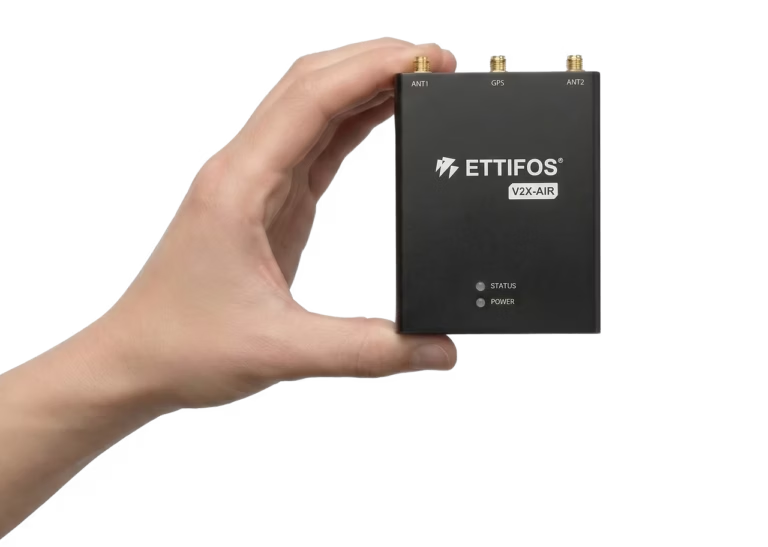
Ettifos will supply its V2X-AIR aftermarket OBU to support the scheme’s V2X applications, as part of a multi-vendor deployment bringing together V2X solutions from various suppliers to create an interoperable environment intended to support deployment scalability and sustainability.
Aftermarket unit targets existing vehicles
V2X-AIR is a compact OBU compliant with the Build America, Buy America Act (BABA), designed to bring existing vehicles into the connected transportation ecosystem without requiring factory-integrated V2X hardware. It supports cellular vehicle-to-everything (C-V2X) direct communications, enabling vehicles to receive and exchange safety and mobility information with connected roadside infrastructure and other connected road users.
Bringing older or unequipped vehicles into a connected network in this way is intended to widen the pool of vehicles able to take part in V2X schemes, without requiring fleets to be replaced or retrofitted with factory-fitted systems. The device pairs with a smartphone over Bluetooth 5.0 to deliver connected vehicle services without a dedicated in-vehicle display, and is available in C-V2X or dedicated short-range communications (DSRC) radio variants. It runs on an NXP i.MX 8XL processor under Linux and is powered via a 5V/3A USB Type-C connection.

Applications include freight and transit priority
CVAZ’s V2X applications include Emergency Vehicle Preemption, Vulnerable Road User safety, Transit Signal Priority and Freight Signal Priority, intended to improve situational awareness and safety while supporting the efficient movement of emergency, transit and freight vehicles.
The deployment covers key corridors and communities across Maricopa County, including Phoenix, Tolleson, Avondale and unincorporated areas, as well as Arizona Department of Transportation (ADOT) corridors such as US 60.
MCDOT has worked on connected vehicle technology since 2008 through its SMARTDrive programme, evaluating V2X applications alongside ADOT, the University of Arizona and the Arizona Commerce Authority’s Institute of Automated Mobility at the Anthem Test Bed, a 5.3-mile corridor with 11 connected intersections north of Phoenix. CVAZ extends that work to a larger, multi-vendor deployment.
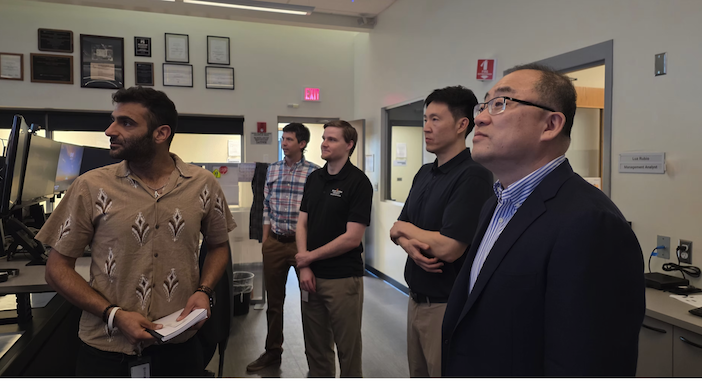
Hojun Kim, chief executive of Ettifos, says the project marks a step toward scalable, real-world V2X deployment in the US.
“CVAZ represents an important step toward real-world, scalable V2X deployments in the US,” he says. “We are proud to support the project with V2X-AIR and demonstrate how Ettifos’ technology can connect existing vehicles to safer, smarter transportation networks across Maricopa County.
“Deployments like CVAZ are essential to proving the value of V2X technology at scale and accelerating its adoption across the US.”
For more on the FHWA’s Saving Lives with Connectivity programme, including an exclusive interview with Maricopa County’s project leader Joe Cottrell, don’t miss our in-depth feature in the forthcoming October edition of TTi magazine.