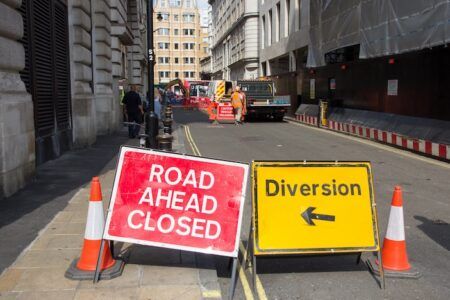



When so much driving behavior is dictated by satnavs, how can road operators effectively implement work zone diversions? Tom Stone meets experts who are harnessing real-time data to deliver next-generation rerouting
When work zones force closures on major routes, road operators are duty bound to put diversions in place. Twenty years ago, traffic managers might reasonably have expected these diversions to be followed by almost all drivers – but that was before the large-scale uptake of satnavs.
These days there are two types of drivers: those who dutifully follow posted diversions and those who trust their satnavs to find a better way. And increasingly it’s this second group that is winning the race.
A recent case study of road closures on one of Europe’s busiest roads – the London-orbital M25, which has approximately 150,000 journeys per day – revealed surprising insights about driver behavior. The UK’s BT (formerly British Telecom) used floating data from its mobile network EE to give insights into how diversions were being used. “We found at one point that only 11% of people actually followed the diversion route,” says Nathan Watt, senior commercial manager at BT, who met with TTi at the Highways UK event in Birmingham in October 2024. “What’s interesting is that often it was actually quicker for people to choose their own routes.”
“We can suggest the implications of diversions ahead of time. I think it’s really important that we’re not just reacting to what’s going on as it happens”
Nathan Watt, senior commercial manager, BT
The data also revealed patterns about how different groups respond to diversions. “The further away your destination is from the diversion route, the more likely you were to actually follow it,” say Watt. “In this case, 30% of the drivers completing the full diversion route were on a journey that started or ended more than 50 miles away. The group that is least likely to follow diversion routes is aged 25 to 34. After that, the general rule is, the older you get, the more likely you are to be obedient to the diversion route.”
Taking back control
While distributing traffic across networks is desirable for road operators, relying on third-party navigation apps to enable this is less so. The data used in free smartphone navigation applications is not completely real-time – and delays in data delivery can mean delays for individual drivers, and impacts on the wider network. Also, third-party recommendations are not easy to predict in planning stages, and, furthermore are not available to those without a smartphone, an interrupted or expired data plan or a simple flat battery.
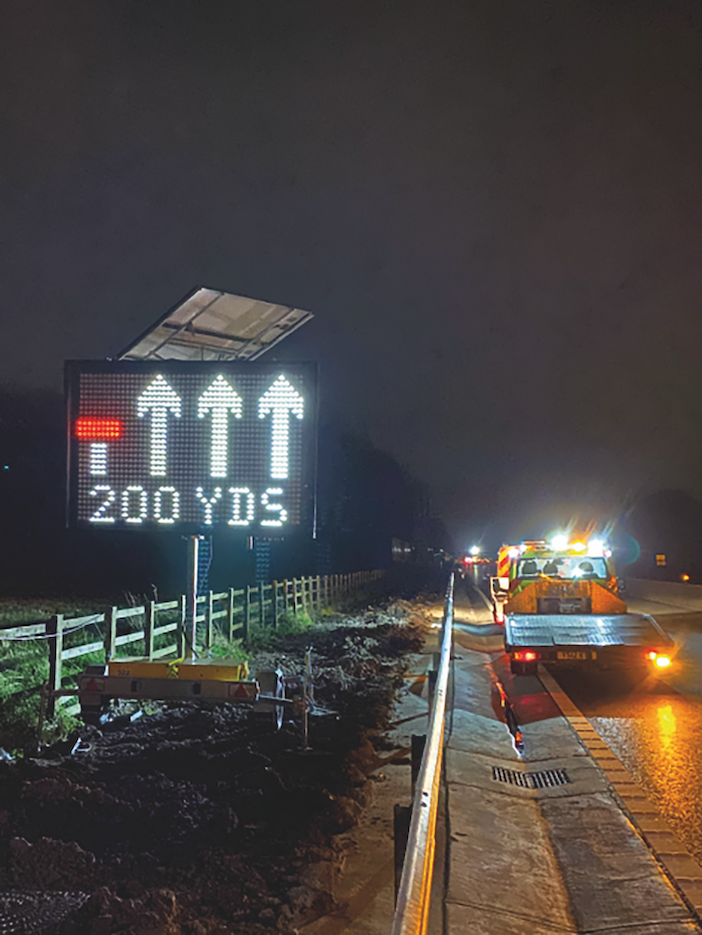
Moreover, if there is an emergency, road operators would like to have the ability to redirect traffic instantly, without having to wait for the information to percolate through to drivers via apps. At the heart of this challenge lies information and trust. While satnavs are in fact performing a valuable service by redistributing traffic, if drivers lose all trust in diversion routes an over-reliance on third party apps could be detrimental to all.
While permanent variable message signs (VMS) are common on major routes, often diversions are still signposted using static signs. Why should a driver trust a static sign when they have a near-live traffic map on, or attached to, their dashboard?
This challenge is leading road operators to smarten up their diversion tactics – and there’s good reason to do so. The economic impact of poorly planned diversions is substantial. “We’re looking at £14,000 per hour during a SRN [Strategic Road Network] closure,” says Sam Li, senior innovation officer at Transport for Greater Manchester (TfGM), who also spoke at the Highways UK event.
Part of the solution comes in delivering smart, dynamic VMS that are temporary in nature, but linked to real-time data streams, which means drivers can get instant information about how long a diversion route will take. This solution can become particularly powerful when it is deployed across a number of different diversion routes, meaning that drivers can be dynamically directed down different routes depending on their location and the current traffic conditions
This is exactly what happened in a project in Australia, when as part of the Western Roads Upgrade initiative in Melbourne, WBHO Australia was appointed to upgrade a major interchange between Princess Freeway and Forsyth Road.
Ahead of the works traffic data analytics firm Mooven monitored 17 different baseline diversion routes to plan out which would work best, without having to use any additional data-collection hardware.
The detour solution saw the deployment of six VMS: four displaying dynamic detour messages and two showing total trip times. With the well-planned diversion, drivers were able to take the best route at any given time.
The smart diversion plan meant the construction time could be halved as it allowed for a total road closure of five weeks, as opposed the originally planned 10 weeks with only one lane operational. “We didn’t receive any complaints for the duration of the work. Drivers quickly adapted and used the alternate roads,” says Dieter Burkhardt, a traffic engineer for WBHO.
Signs of the times
In order to deliver real-time information via signage, advanced VMS are required. For example the UK’s MobileVMS Intelligent Transport Solutions offers a Highways Variable Message Sign that includes JamLogic software to enable remote programming and control, as well as the integration of additional roadside hardware and third-party data sources.
The Mobile VMS Highways VMS were recently used on the M4 Junction 3-12 upgrade project, which included 51km of narrow lanes and onsite construction activities that meant VMS locations often had to be altered at very short notice, each location change required a change to the journey time integration and displayed routes.
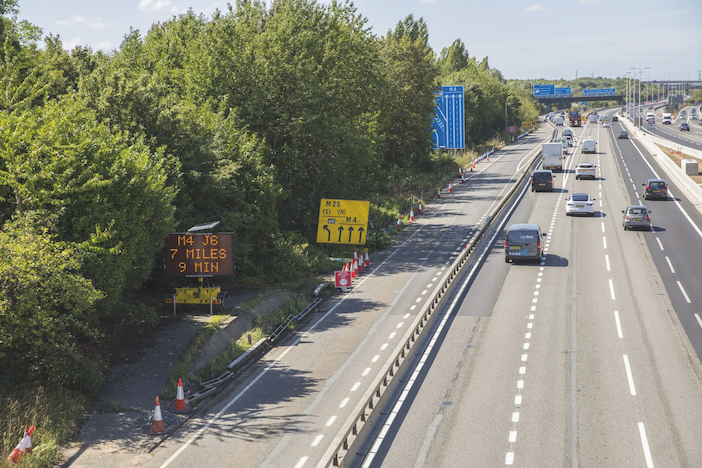
“As the project grew and there were additional requirements beyond the initial contract, the Mobile VMS team delivered efficiently and integrated journey time reliability technologies seamlessly,” says Mark Neville, Senior Traffic Manager for the M4 J3-12 Motorway Upgrade.
Another UK provider of portable VMS is MVIS, who are collaborating with Mooven to provide up-to-date travel time information to it screens. MVIS VMS can be remotely controlled and updated via wireless communication, allowing for instant changes in displayed messages as situations evolve.
Knock-on effects
But no matter how well diversions are planned, or how much real-time information is provided, there will always be knock-on effects to surrounding roads not officially included in diversion routes, so it pays for road operators to plan for these with signal optimization, for example. However, getting this planning right relies on having the right data to hand.
“What’s been really interesting is that, as an organization, all of this data isn’t commonly in one place at the moment,” says TfGM’s Li. “Some of it sits at local authorities, some of it sits at different regions. We’re trying to collect all of this together to get that complete picture of what the impacts are.”
“In reality, we don’t want to divert everybody down one road and that becomes congested. It’s about how we balance that in the schedule and in real time”
Sam Li, senior innovation officer, Transport for Greater Manchester
BT is working on enhancing predictive analytics and real-time management, and is also using end-to-end journey information to understand not only what diversion routes drivers are on, but also their origin and final destination. “We’re moving to both real-time and prediction with our insights,” says Watt. “So we can suggest some of the implications of diversions ahead of time. I think its really important that we’re not just reacting to what’s going on as it happens.”
Li adds that collaboration with navigation providers is the next frontier: “With players like Waze, the next step in the conversation is what are they willing to take from us in terms of recommendations for load balancing.
“In reality, we don’t want to divert everybody down one road and that becomes congested. It’s about how we balance that in the schedule and in real time. We also need to factor in events that could cause additional disruption to existing diversions.”
Data can also help to enable travelers to plan not just alternative routes, but alternative modes, too. “When disruption happens, we are forced to look at new routes and new ways of traveling,” says Li. “Data helps us to push new demand-management options or other travel options,. As local authority partners and players, we always focus very much on our roads, but for the customer, they don’t really care – it’s all cross boundary.”

The Manchester region has a target to achieve net zero by 2038, but in order to do this it’s not going to be enough simply for combustion engine vehicles to be switched to EVs. TfGM is in a more powerful position to drive modal shift than some other authorities as, using the model from London, it has recently taken city bus services under its control.
“Behavior change to sustainable modes is critical,” says Li. “But in order for that to play out, we need more sustainable and more reliable transport provision. Reliability is the key for our customers. If they don’t feel they can trust us that the bus will turn up, we’re going to lose that long-term battle and they’re just going to go back to the cars.”
“Diversion routes can be an opportunity,” agrees Watt. “They can be a way that we can shift people to better modes of transport, and they can be a way that we can shift people to make the journeys we want them to make on our road network. But imperative to that is having good data that sits behind it.”
This feature was first published in the December 2024 edition of TTi magazine