


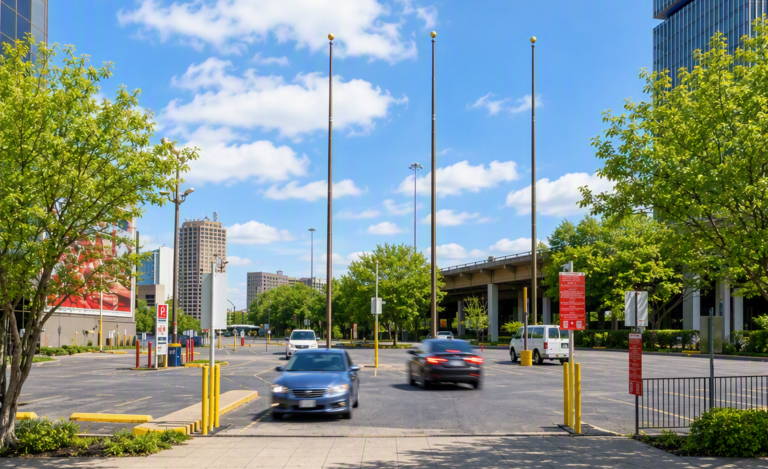
Free-flow parking already removed the barrier, the ticket machine, and the attendant. Serverless processing on the camera chipset removes the next piece of equipment: the server itself, Asura Technologies reports
Free-flow parking’s defining trait is what it removes. Barrier arms, ticket machines, and attendant booths, once standard at every site, have already disappeared from a growing share of new car parks, replaced by cameras that read a plate on the way in and match it on the way out. That removal of equipment is one driver behind a market projected to grow from US$12.3bn in 2026 to US$53.4bn by 2033, a compound annual growth rate of 23.3%, according to Grand View Research.
The next piece of equipment on that list is the server: camera-based enforcement systems still typically rely on a local server or compute box on site, and every additional site still requires its own server hardware, networking, and power provisioning.
That cost is manageable at high-volume locations such as airports, but far harder to justify at the dispersed, lower-margin sites driving most of the market’s growth: neighbourhood car parks, hospital lots, campus parking, and short-term or roadside deployments.
Moving intelligence onto the chip
A broader shift in how AI workloads are deployed offers a way to remove that last piece of hardware too. The global edge AI market, valued at an estimated US$30bn in 2026, is forecast to reach US$118.7bn by 2033, with hardware already accounting for more than half of market revenue, according to Grand View Research, reflecting a shift of processing onto the device generating the data.
Applied to parking and traffic cameras, this means running recognition and decision logic directly on the chipset embedded in the camera, rather than a separate server: no rack and cooling box, no server operating system to patch, and only the resulting event, a plate match, an overstay flag, an access decision, transmitted rather than a continuous video stream. The result: lower ongoing support and easy configuration on camera.
Beyond plate recognition
What runs on that chip has also broadened beyond plate recognition. The same on-device processing can identify a vehicle’s colour, make, model, or category, count its axles, detect an ADR placard indicating dangerous goods, or read a visible USDOT number, depending on which recognition models are loaded. Because this software is decoupled from any single hardware line, new attribute models can be deployed to cameras already in the field through a standard update.
Installation is reduced to mounting a camera and connecting power, rather than provisioning an equipment room, and maintenance is simpler with fewer components to fail. One caveat: a chipset’s compute budget is fixed at manufacture, so hardware still needs headroom for future workloads, though the software running on it keeps expanding through updates.
“Sites that could not previously justify camera-based enforcement become viable, and the solution scales across dispersed locations as independent nodes”
A natural proving ground
Free-flow parking is a natural proving ground for this architecture, given its many dispersed sites, high throughput, and limited on-site staff; attribute recognition adds to this, with colour, make, and model confirming a vehicle beyond the plate, and USDOT numbers extending the same camera to commercial-vehicle checks.
The same characteristics extend to temporary enforcement zones, mobile deployments, and rural highways, where ADR placards and USDOT numbers can be flagged without added sensors or servers, and to city-wide traffic monitoring, where aggregated vehicle counts and different movement patterns build a complete dataset that would otherwise need a dedicated sensor network.
The economic case
The direct effect is economic: sites that could not previously justify camera-based enforcement become viable, and the solution scales across dispersed locations as independent nodes without each carrying the fixed overhead of a local server. Free-flow parking already showed what happens when equipment is removed from the customer-facing side of a site, in barriers, tickets, and attendant booths; removing the server does the same on the infrastructure side, leaving enforcement and monitoring with close to as little physical footprint as it is likely to have.
By moving recognition and decision logic onto the camera itself, operators eliminate the servers, the maintenance overhead, and the bandwidth costs that traditional video-based systems require. As a result, operators will see a significantly lower total cost of ownership.