

Coventry University has launched drone delivery research examining whether unmanned aerial vehicles can be scaled up to improve emergency preparedness in cities.
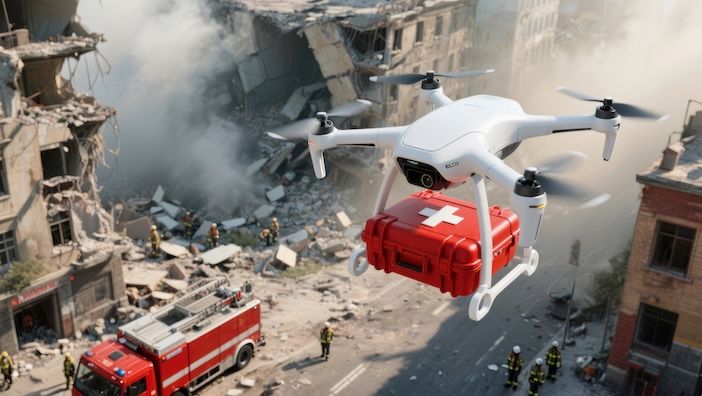
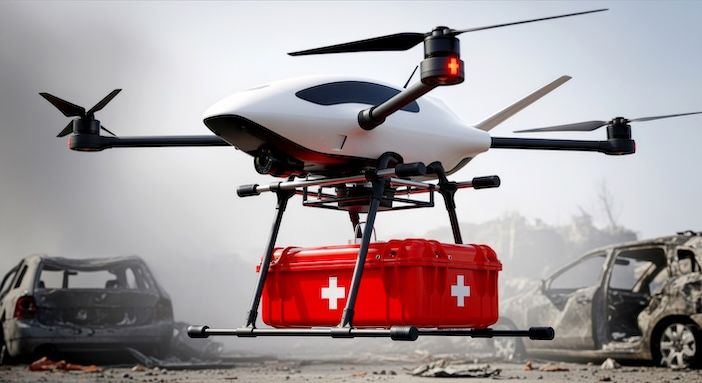
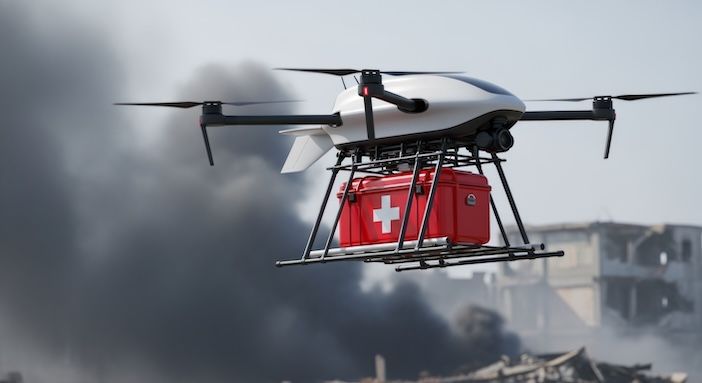
The Urban Ascent project brings together Coventry City Council, Skyfarer, The Manufacturing Technology Centre and Slink-Tech to investigate whether drones could deliver critical medical supplies, map city structures, accelerate disaster response, support search and rescue operations and provide communication in remote areas.
Funded by a government grant through Innovate UK and the Department for Transport’s Future Flight Regional Demonstrator programme, the drone delivery research aims to establish Coventry and the UK as a hub for urban aerial logistics and sustainable aviation.
Commercial feasibility at heart of research
Coventry University’s contribution to the drone delivery research focuses on examining whether specific drone applications within urban environments are commercially feasible and whether they can be upscaled.

Dr Safaa Sindi, assistant professor of supply chain operations at Coventry University’s Research Centre for Future Transport and Cities and principal investigator on the university’s aspect of the project, explained the advantages and challenges of urban drone operations.
“The main advantage of using drones is the speed, they avoid traffic, can reach remote or hard to access areas and they are sustainable,” says Sindi. “One of the main challenges of using drones within an urban environment is clutter and how they can operate within a space that is already used by vehicles, pedestrians and wildlife.”
Sindi emphasized that the drone delivery research targets specific emergency applications rather than routine commercial deliveries. “However we are only talking about specific uses, this isn’t about not getting your Amazon parcel delivered by a drone,” she says.
Validating business case for emergency drone operations
The university’s role centers on validating the business case for emergency drone use. The drone delivery research will examine whether these applications can be commercially viable and upscaled for wider deployment.
“We’re validating the business case for using drones in this way,” Sindi said. “We’re at a stage now where the technology is ahead of current regulations regarding drones so part of this project concerns coming up with policies regarding commercial drone use that can be widely adopted, which could include designated drone superhighways.”
The drone delivery research will also explore different business models, including whether it would be more cost effective for the technology to be leased and maintained by external providers rather than owned by municipalities or emergency services.
West Midlands is ideal testing environment
The project specifically focuses on Coventry and the West Midlands region, which offers researchers a mix of urban and rural environments to examine drone applications across different settings.
Councillor Jim O’Boyle, cabinet member for jobs, regeneration and climate change at Coventry City Council, highlighted existing drone applications in controlled environments. “Drones are already proving that they can support work in controlled environments – including tasks such as observing traffic movements and investigating bridge structures,” he says.
“The next step is to see if this can transfer to a larger and maybe even commercial scale. It’s great we are working with local partners on this project – it’s a great fit with the city’s pioneering role in innovation.”
Building on aviation technology expertise
Coventry University brings significant expertise in aviation technology to the drone delivery research. The institution played a key role in designing Air One, the world’s first urban air transport hub.
The Future Flight Regional Demonstrator programme funding supports work developing next-generation aviation technologies. Through Urban Ascent, researchers hope the drone delivery research will establish frameworks for commercial drone operations that can be widely adopted across the UK and internationally.
The project represents a shift from technology development to practical implementation, examining how drone systems can integrate into existing urban infrastructure while addressing regulatory gaps and establishing sustainable business models for emergency response applications.
Drone images ©AdobeStock