

At the 2026 ITS World Congress in Gangneung, ITS Korea supported the Ministerial Meeting and high-level talks, while running the Korea ITS Pavilion and a business matching programme. By pursuing policy cooperation and industry support side by side, it helped turn discussions at the Congress into overseas business opportunities for Korean ITS companies.
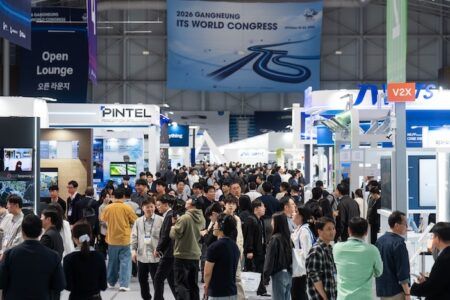
The 2026 ITS World Congress was held in Gangneung from 19 to 23 October. Following Seoul in 1998 and Busan in 2010, it was the third ITS World Congress to be held in Korea, co-hosted by Korea’s Ministry of Land, Infrastructure and Transport (MOLIT) and Gangneung City. Under the theme “Beyond Mobility, Connected World”, 108 organisations and companies ran 428 booths, and 193 technical sessions took place.
During the event government-to-government discussions opened the door to cooperation, and business meetings turned those opportunities into concrete projects, with the business matching programme hosting a total of 492 meetings.
Ministerial Meeting: setting the direction for AI-driven ITS
The Ministerial Meeting, hosted by MOLIT on 19 October, brought together ministers and representatives from 12 countries and international organisations, including IRF and UNECE. Germany presented C-ITS advance warnings for motorway roadworks, Singapore its shift to GNSS-based road charging, and Kazakhstan its use of AI gates to cut border waiting times to a tenth. Korea shared the AI-focused revision of its ITS Master Plan 2030 and results from AI-based incident detection using expressway CCTV. Participants adopted five Key Messages:
- ITS evolving with AI
- Smart mobility advanced by data
- ITS for all
- Building the future of ITS through connection and cooperation
- Carrying future mobility forward from Gangneung
Laying the groundwork for government cooperation
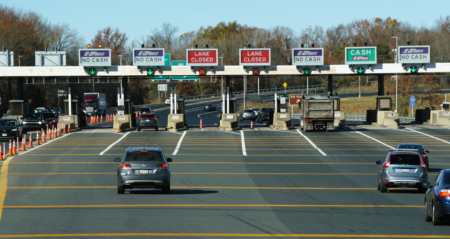
ITS Korea supported 10 bilateral meetings held by MOLIT. Discussions with Malaysia focused on multi-lane free-flow (MLFF) tolling on expressways, and those with Vietnam and Uzbekistan on ITS deployment and infrastructure projects. With the US Department of Transportation (USDOT), the two sides shared Korea’s ITS Master Plan 2030 and the US Digital Corridor Initiative (DCI).
Talks with UNECE covered greater Korean participation in automated driving regulations, while talks with Japan covered automated trucks and AI-based road management. In three-way meetings with the transport ministries of four countries, held together with the Asian Development Bank’s K-Hub, the partners firmed up plans for pilot projects and consulting cooperation.
Korea ITS Pavilion and the AX-Sprint Pavilion
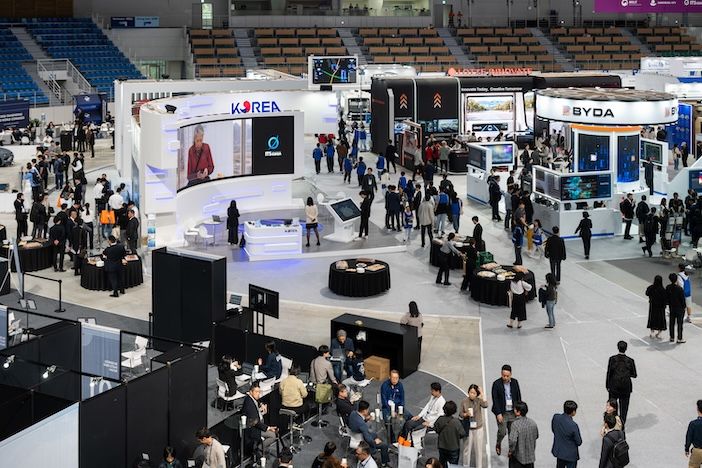
At the Korea ITS Pavilion, ITS Korea led guided tours for more than 600 participants from 50 organisations, including ministers and vice-ministers from Korea and abroad. Tour groups included training delegations from Medellín in Colombia and from Peru, a US smart mobility centre and Abu Dhabi’s Integrated Transport Centre. When visitors described the technologies they were interested in, staff took them straight to the stands of the relevant Korean companies, turning visits into business conversations.
The integrated pavilion for AX-Sprint, a programme that helps bring innovative AI transport technologies onto real roads within one to two years, welcomed more than 400 visitors a day on average. It ran 20 guided tours for VIPs and 10 general tours in Korean and English, and led to six business matches and three stage pitching and IR sessions.
Success for business matching programme
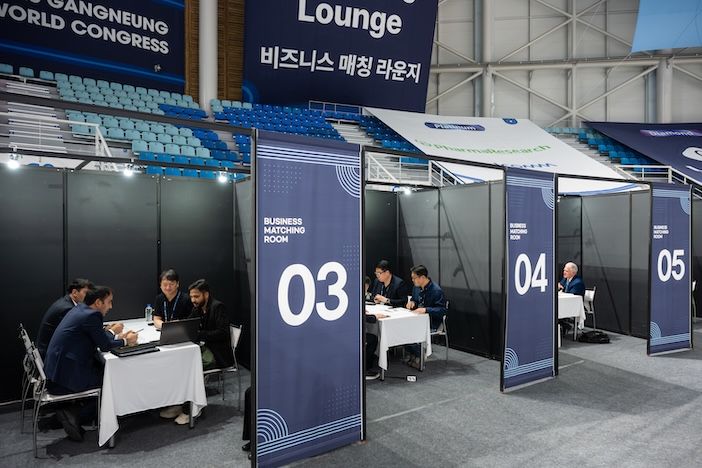
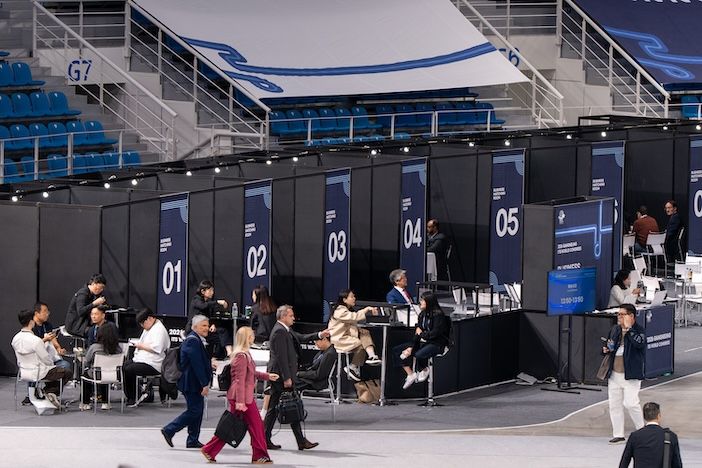
ITS Korea’s business matching programme supported a total of 492 meetings: 423 at company stands and 69 in the business lounge. The lounge also hosted 10 meetings between eight Korean companies and the transport ministries of Ireland, Kazakhstan, Tajikistan and Uzbekistan, giving overseas governments a chance to see Korean technologies first-hand and discuss cooperation. These meetings led to 11 MoUs and two contracts, with companies such as Ranix, BYDA and DEEPX signing agreements with partners in Singapore, Japan and Vietnam.
ITS Korea also ran programmes to strengthen companies’ export capabilities. An export support session introduced government schemes such as export vouchers and export finance, and provided tailored consultations for 50 participants from nine organisations. At the K-NPU transition support meetup, 30 companies shared how Korean AI semiconductors can be applied to ITS, resulting in 19 business matches.
“We will stay with Korean companies every step of the way until the conversations that began in Gangneung turn into business overseas. We will keep expanding our role in connecting governments, international organisations and industry.” – Cheong-Hoe Heo, Chairman, ITS Korea
More information: https://itskorea.kr/english/main.do