

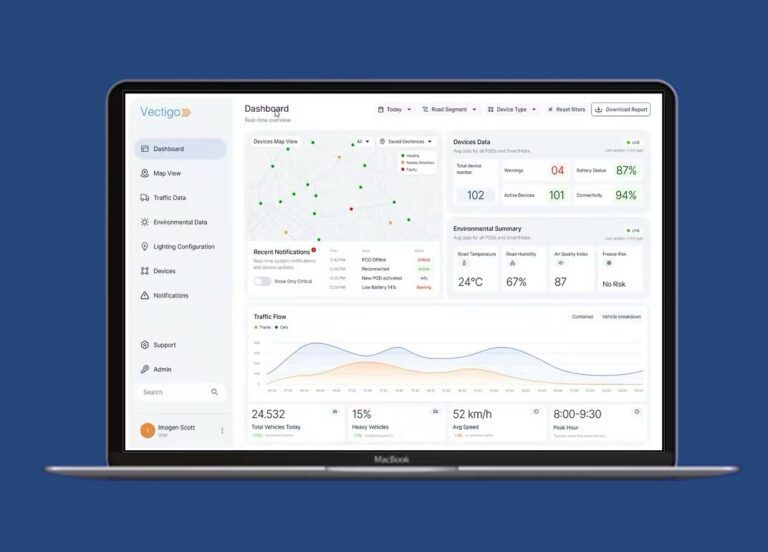
Vectigo has launched its roadway-embedded safety platform in Colorado, installing solar-powered sensor units flush between lane stripes to detect black ice, wrong-way vehicles, crashes and closures, and to share lane-level data with drivers, emergency responders, freight operators and autonomous vehicle (AV) fleets.
Vectigo LLC, the US division of Vectigo Group Limited, announced the Colorado launch of the Vectigo Platform on 28 October. It is working with national distribution and installation partner RoadSafe Traffic Systems.
How the platform works
Each Vectigo POD is installed flush with the road surface, between every other stripe on the road. The units are solar-powered and grid-independent, so installation requires no trenching for power and operation continues during outages.
The platform is sensor-agnostic, meaning each installation can be configured for the hazards found locally. Agencies can download the data and share it with emergency responders, other public agencies and AV operators.
The PODs also provide grid-independent lane lighting that outlines the lane in snow, rain and darkness and switches off when the road is empty.
According to Vectigo, the technology behind the platform has been shown to reduce accidents by 70 per cent and injury-causing accidents by 50 per cent for human-driven vehicles. The company says the system works with every vehicle on the road today, with no special equipment, app or new car required, through lane lighting, dynamic signage, navigation and 511 integrations.

Hazards detected
The platform reads conditions directly from the road surface, lane by lane, and shares them in real time:
- Snow and black ice: in-lane surface-temperature sensing identifies black ice and freezing conditions before they are visible and tracks snow-covered lanes, so drivers can be warned, road crews can target treatment and traffic can avoid the most dangerous stretches.
- Wrong-way drivers: the platform detects a wrong-way vehicle as it enters the lane and alerts law enforcement, responders and oncoming traffic within seconds.
- Closures and crashes: stoppages, crashes, closures, flooding and rockfalls are reported as they happen so traffic can be routed around them.
- Dynamic lighting: lane lighting operates independently of the grid.
Road deaths in Colorado
Vectigo points to figures from the Colorado Department of Transportation (CDOT), which reports that 701 people were killed on Colorado roads in 2025, up from 689 in 2024, ending two years of decline. In Denver, traffic deaths rose 21 per cent to 76, according to Denver7.
“This platform is designed to reduce crashes and save lives for everyday drivers first,” says Brendan Lundy, executive chairman of Vectigo Group Limited. “Every winter, Colorado drivers face black ice they cannot see, wrong-way drivers they cannot anticipate and closures they cannot avoid. Vectigo detects those dangers in the lane and gets that information to the drivers, first responders and truckers who need it, in time to change course.”
Emergency responders and freight
For emergency medical technicians, fire crews and police, the platform provides lane-level visibility of icing, flooding, crashes and closures. Vectigo says this lets responders choose the fastest safe route to the scene and the hospital.
For freight, the company notes that a single crash or closure on a mountain corridor can strand trucks for hours. Real-time closure, accident and black-ice data lets dispatchers reroute fleets early, which Vectigo says keeps drivers out of dangerous conditions and reduces secondary crashes.
Data for autonomous vehicles
AVs rely on cameras, radar and lidar, which cannot directly sense surface conditions such as ice or standing water and can be degraded by snow, glare and faded lane markings. Vectigo says its platform adds an independent, redundant layer of verified data from the roadway itself, covering surface temperature, icing, water, lane position, wrong-way movement and incidents ahead.
“The same data gives autonomous vehicles the redundancy they need to operate safely,” adds Lundy. “Colorado is where we will prove it, and the model for roads across the U.S. and the world.”
Performance commitments and rollout
Vectigo backs each deployment with a 95 per cent uptime standard for lighting and data, quarterly performance reporting to the agency’s program lead and defined restoration timelines after any outage.
Colorado is one of the company’s first priority states in a national rollout that aims to reach every state department of transportation within five years, alongside expansion across Europe and the Middle East. RoadSafe Traffic Systems is the national distributor and installer of the platform in the US.